
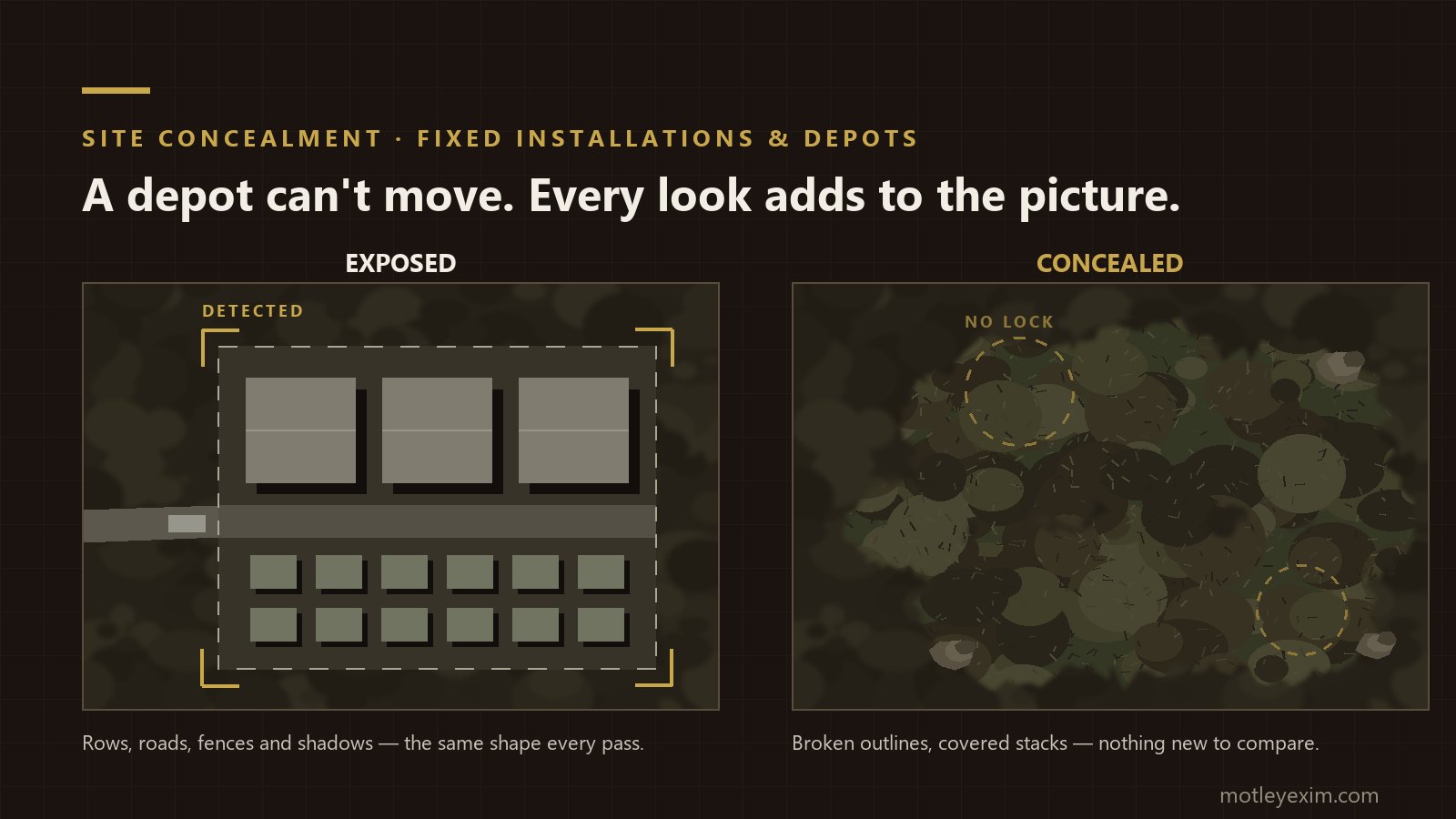
Camouflage on a mobile unit only has to buy time until it moves. A depot, ammunition store or fixed installation never gets that option. It sits in one place for months or years, it covers a large and regular footprint, and it has a routine that an observer can watch repeat. That turns concealment from a single decision into a long-term discipline. This guide builds on our work on concealment from satellite and aerial ISR and concealing helipads and airfields to look at the sites that have to stay hidden without ever leaving.
TL;DR
- Time works against a fixed site. An observer can keep coming back, and every change adds to the picture.
- Change detection is the real threat. New tracks, stacks and routines stand out when today's image is compared with last month's.
- Rows of sheds, straight roads, fence lines and hard shadows are the shapes overhead sensors look for first.
- Roofs, generators and stored equipment hold heat and reflect radar — visual cover alone is not enough.
- Fixed-site cover is a maintenance programme, not a one-off purchase: faded, sagging nets stop matching the terrain.
Why fixed sites are a different concealment problem
Mobile units hide partly by moving. Even an imperfect position can survive if it relocates before a sensor builds a clear picture of it. A depot, fuel point, storage yard or fixed installation has no such escape. It stays where it is, so an adversary can observe it again and again — from satellites on a revisit cycle, from aircraft, or from drones loitering overhead — and every observation adds to what came before.
That changes the goal. Hiding a fixed site is less about surviving one look and more about staying unremarkable over weeks and months: the site has to look the same, look like its surroundings, and avoid the patterns of activity that give its purpose away. Our note on camouflage and concealment doctrine covers the discipline side of that problem.
Change detection: what gives a depot away over time
Change detection compares images of the same place taken at different times and highlights what is new. For a fixed site it is often more revealing than any single photograph. Fresh vehicle tracks, a new line of stacks, a cleared patch of ground, a building that appeared between two passes or a truck parked in the same spot every morning all stand out against the earlier picture, even when each looks harmless on its own.
The most dangerous moment is often construction. Ground scars, spoil heaps, new roads and fencing are easiest to spot while they are fresh, so concealment that arrives after the site is built starts at a disadvantage. The routine that follows matters just as much: regular deliveries, lighting at night and predictable movement between buildings create a pattern of life that persistent aerial and satellite observation is designed to pick up.
Breaking up rows, roads, fences and shadows
Storage sites are built for efficiency, which makes them geometric: parallel sheds, evenly spaced stacks, straight access roads and long fence lines. Those regular shapes rarely occur in nature, and from altitude they are among the first things an analyst or an automated detection model notices. Colour matching on its own does little against them — a straight road is still a straight road.
Effective cover breaks the geometry at the scale of the whole site. That means continuous, properly sized net coverage over stacks and structures, a support system that holds the net clear of what lies beneath and slopes its edges to the ground so they do not cast hard shadow lines, and three-dimensional multispectral nets that add the texture a flat cover lacks. Hard features that are awkward to net — bunker entrances, tunnel gates and small sheds — can be blended into the terrain with engineered camouflage rocks.
Heat and radar signatures of a static site
A fixed site has heat sources that never go away. Roofs and hardstandings absorb sunlight and release it after dark at a different rate from the ground around them; generators, vehicles and stored equipment add their own thermal signature. A depot that is well hidden to the eye can still stand out clearly on a thermal image, which is why cover needs to work across the visible band, near-infrared (NIR), short-wave infrared (SWIR) and thermal infrared together — our spectrum explainer shows what each band reveals. Anti-thermal coatings and camouflage paints can reduce the contrast of exposed roofs and structures.
Radar sees something different again. Metal roofs, stacked equipment and parked vehicles reflect radar energy strongly, and synthetic-aperture radar can pick up that radar cross-section by day or night and through cloud. Over stored equipment, a radar-attenuating multispectral net helps reduce that return; where radios or radar inside the site must keep working, a radar-transparent multispectral net conceals in the optical and thermal bands without blocking their signals.
Built for long dwell: durability and maintenance
Camouflage on a mobile position may only need to last a deployment. Cover on a fixed site has to survive long, continuous exposure to sun, rain, dust and wind. Colours fade, garnish loosens, supports sag and nets collect debris — and a worn net gradually stops matching the terrain it was chosen for, which is exactly the kind of change an observer notices. Wet seasons add their own stresses; our guide to camouflage in monsoon and wet climates covers them.
That makes maintenance part of the concealment plan: routine inspections, replacement of faded or damaged sections, and seasonal adjustment as vegetation changes colour — all carried out without cutting new tracks or creating a visible pattern of work. Near fuel and ammunition stores, fire behaviour matters too; our fire-suppression buyer guide covers fire protection for magazines and shelters.
What to specify for a depot or fixed installation
Seven questions cover most of what a fixed-site cover plan has to answer:
- The terrain and its seasons — soil, vegetation, rock or snow around the site, and how they change through the year (see our desert and mountain terrain guides).
- Multispectral coverage — visible, NIR, SWIR and thermal together, not a visual-only pattern.
- Radar behaviour — radar-attenuating over stored equipment and vehicles, radar-transparent over systems that must keep transmitting.
- Footprint, structure and shadows — continuous coverage for the whole site, supports that keep nets clear, and edges sloped to the ground.
- Durability for long exposure — resistance to sun, rain, dust and wind, plus fire retardancy near fuel and ammunition.
- Activity discipline — tracks, lighting, deliveries and routines that do not reveal the site's purpose.
- Inspection and maintenance — a plan to keep cover matched to the terrain for the life of the site.
CAMPRO® multispectral camouflage nets are manufactured in India, with NABL-accredited lab test reports available on request; defence exports are subject to India's SCOMET export-control framework. For the broader requirement, see how to specify a multispectral camouflage net, our anti-drone camouflage solutions and the complete guide to camouflage nets.
Frequently Asked Questions
Why are depots and fixed installations harder to conceal than mobile units?
Because they cannot use movement to break observation. A mobile unit can relocate before a sensor builds a picture of it; a depot sits in the same place for months or years, so an observer can keep coming back. Every new track, structure or pattern of activity accumulates, and the site's large, regular footprint — rows of sheds, stacks, roads and fences — is exactly the kind of shape overhead observation is built to find.
What is change detection and why does it matter for a fixed site?
Change detection means comparing images of the same place taken at different times and looking at what is new or different. For a fixed site it is often more revealing than any single image: a fresh track, a new stack, a vehicle that appears every morning or a cleared patch of ground stands out against the earlier picture. Good concealment therefore aims to keep the site looking the same over time, not just to hide it in one image.
Can camouflage nets cover a large depot or storage area?
Yes, but coverage has to be planned as a system rather than as individual nets. Large areas need nets joined into continuous cover, a support structure that holds the net clear of the objects underneath and slopes its edges to the ground to avoid hard shadows, and a pattern scale that still works from altitude. Hard features such as bunker entrances or tunnel gates can be blended into the terrain with engineered, rock-like structures instead of netting.
How do you stop a fixed site from standing out on thermal imaging?
By managing heat at its sources and the contrast around it. Roofs, generators, vehicles and stored equipment absorb and release heat differently from the surrounding ground, so a site hidden to the eye can still show up on a thermal image. Multispectral nets that work across visible, near-infrared, short-wave infrared and thermal bands, anti-thermal coatings on exposed structures, and careful placement of heat sources all reduce that contrast.
How long does camouflage on a fixed site stay effective?
Only as long as it is maintained. Long exposure to sun, rain, dust and wind fades colours, loosens garnish and sags support structures, and a worn net starts to look different from the terrain it was matched to. Fixed-site cover needs materials chosen for long outdoor exposure, a routine inspection and replacement plan, and maintenance carried out without creating new tracks or patterns of activity.
What should be specified when ordering camouflage for a depot or fixed installation?
Seven things: the terrain and how it changes through the seasons; multispectral coverage across visible, near-infrared, short-wave infrared and thermal bands; radar behaviour — attenuating over stored equipment or transparent over systems that must keep transmitting; the full footprint, support structure and shadow control; durability against sun, rain and wind, plus fire retardancy near stores; activity discipline covering tracks, lighting and routines; and an inspection and maintenance plan for the life of the site.
Procurement or technical question?
CAMPRO® camouflage, CAM-IRR® paint, fire-suppression systems, and export-compliance support. Our team replies within one business day.
Contact Our Team →