
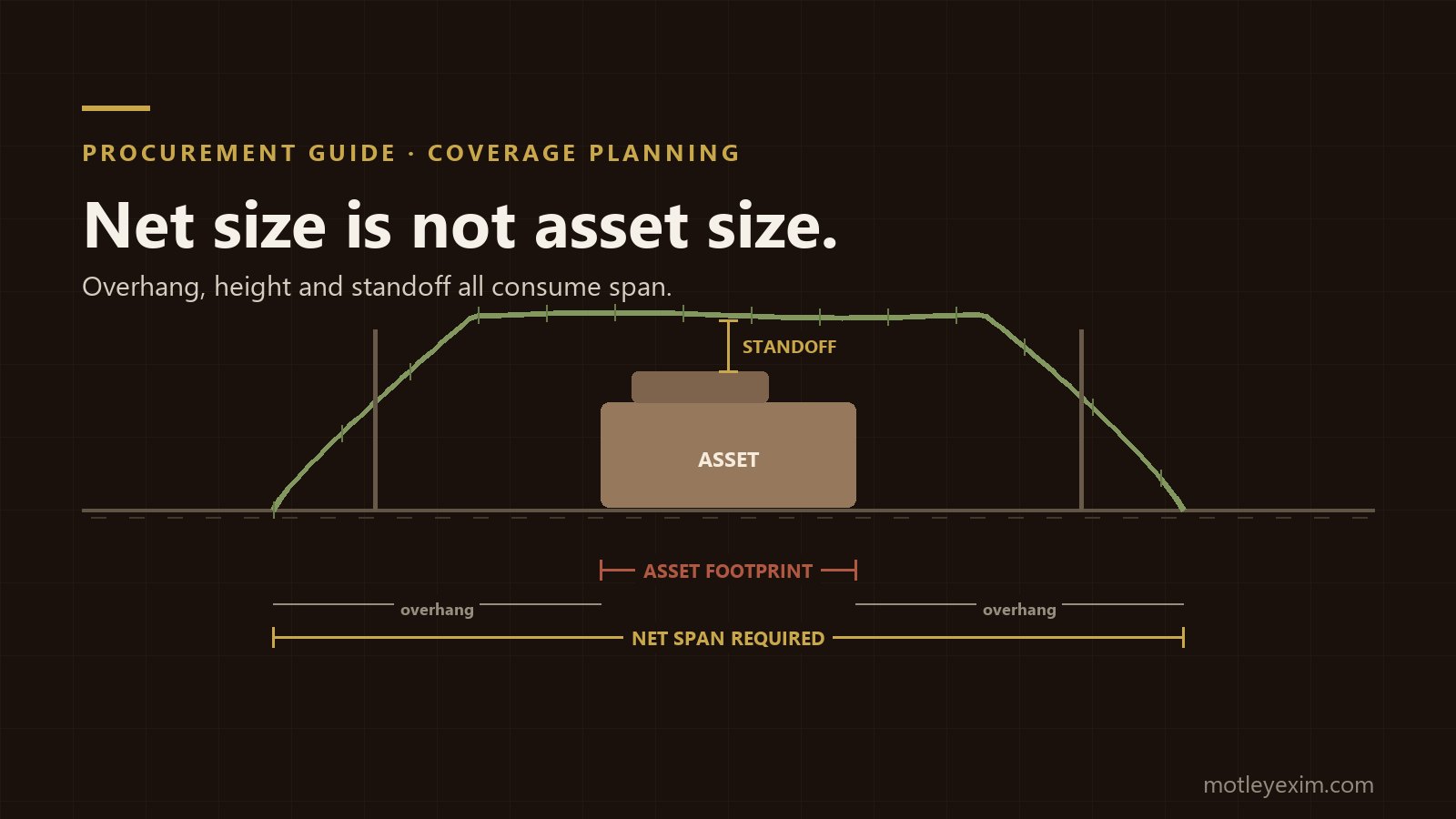
Almost every concealment failure that gets blamed on a net is really a sizing failure. The cover arrives, it goes over the asset, and it stops at the edges — leaving a vertical face, a hard shadow and an outline that reads as a rectangle from the air. The material was never the problem; there was simply not enough of it. This guide sets out what actually consumes net span, so the figure is worked out before a quotation is requested rather than discovered in the field.
TL;DR
- Net size is not asset size. The footprint of the vehicle is the starting point, not the answer.
- Overhang is not optional — a cover that stops at the edge leaves a vertical face and a hard shadow, and shadow is what overhead imagery finds first.
- Height is paid for out of width. Material goes up one side and down the other; standoff for thermal management takes more still.
- Terrain, siting and how often the cover is deployed all change the figure — plan for the worst siting, not the best.
- Six answers let a supplier size properly: dimensions incl. height, quantity and grouping, terrain and finish, whether the position transmits, deployment frequency, and support method.
The footprint is where you start, not where you stop
A requirement usually begins with the asset: a vehicle so many metres long, a shelter so many metres wide. That figure is necessary and entirely insufficient. It describes the ground the asset occupies, not the ground the cover has to reach.
The gap between the two is where most under-ordering happens. A cover sized to the footprint sits on top of the asset like a fitted sheet: it hides the roof, leaves the sides exposed, presents a vertical face at every edge, and throws a hard-edged shadow onto the ground beside it. From ground level this can look adequate. From above — the view that increasingly decides whether a position survives, as covered in our guide to satellite and aerial ISR concealment — it reads as a neat geometric object with a neat geometric shadow, which is precisely what an analyst is trained to find.
Overhang: the part that does the concealing
What turns a cover into concealment is the material beyond the asset. Overhang allows three things that nothing else can provide. It lets the cover reach the ground, so there is no vertical face and no crisp shadow line. It gives enough slack for the perimeter to be broken up and pinned irregularly, so the outline stops being a rectangle. And it creates the transition zone where the cover visually merges with the surrounding ground rather than sitting on it.
How much overhang is a judgement about the threat and the siting, not a universal constant — but the principle is not negotiable. Any calculation that ends at the asset’s edge has produced the wrong number. It is worth being blunt about this at the requirement stage, because overhang is exactly what gets trimmed when someone is trying to reduce a quotation.
Height is paid for out of width
This is the calculation most often missed, and it catches experienced buyers. Material draped over a tall object does not lie flat: it travels up one side, across the top, and down the other. Every metre of height therefore consumes span twice over before any overhang is counted.
Standoff makes the arithmetic sharper still. Thermal concealment depends on the cover not resting on hot surfaces — the gap of air is what stops heat conducting through and turning the cover itself into the warm object a thermal imager sees. Rigging that gap with poles and spacers raises the whole profile, which increases the span the cover must cross. A tall shelter can require noticeably more net than a low vehicle standing on the same size of ground, and a system rigged properly for thermal performance needs more than the same system draped flat.
One large cover, or several joined sections?
Both are legitimate; they solve different problems. A single large cover gives an unbroken surface with no seams to manage and is generally the cleanest concealment for a fixed position that stays put. Against that, it is heavy, slower for a small team to deploy and recover, and a single tear takes the whole cover out of service.
Modular sections joined on site trade a little surface continuity for a great deal of practicality: faster handling, damaged panels replaced individually rather than as a whole, and layouts that adapt to irregular groupings of equipment. The condition is that joins must be overlapped and staggered properly — a straight, aligned seam running the length of a position is a geometric line, and geometric lines are what the eye and the sensor both find. The trade-offs are set out in more detail in our comparison of roll versus modular nets.
Terrain, siting and the honest planning figure
Ground consumes material. A flat hardstanding lets a cover span cleanly; sloping, broken or vegetated ground makes it follow the surface, and following costs more than spanning. Rocky terrain, scrub and slope all pull the effective coverage down from the paper figure.
Siting works in the other direction. A position tucked against a treeline, a bank or a wall borrows concealment from what is already there and can sometimes need less material, provided the natural cover genuinely works across the bands in the threat picture rather than only the visible one. The problem is that units rarely get to choose the ideal site every time. The honest planning figure is therefore based on the worst siting the unit will realistically face, not the best one it might occasionally enjoy — a point that sits alongside the wider siting and discipline considerations in camouflage and concealment doctrine.
What a supplier needs in order to size it properly
Most sizing errors are communication errors. A supplier given only "a net for a truck" is guessing. Six pieces of information remove the guesswork:
- Dimensions including maximum height — length, width and the tallest point, not just the ground footprint.
- Quantity and grouping — assets covered individually, or several under one canopy.
- Terrain and finish — desert, woodland, alpine/snow or urban, and the ground the position will sit on.
- Whether the position transmits — a site running its own radar or communications needs a radar-transparent design rather than an attenuating one.
- Deployment pattern — left in place for long periods, or repeatedly deployed and recovered, which affects both weight and construction.
- Support method — poles and spacers for standoff, or draped, covered further in our note on support-system setup for field operations.
With those answers a supplier can size and specify rather than estimate. For the wider requirement — sensors, bands and test evidence — see how to specify a multispectral camouflage net, and the complete guide to camouflage nets for the underlying principles.
Frequently Asked Questions
How do I work out what size camouflage net I need?
Start from the asset’s footprint, then add for three things it does not include: overhang on every side so the cover reaches the ground, the span consumed by height, and an allowance for the siting you will actually use. The finished figure is always larger than the vehicle or shelter dimensions — and it is worth calculating before requesting a quotation rather than after delivery.
Why does the net have to be bigger than the vehicle?
A cover that stops at the asset’s edge leaves a vertical face and a hard, geometric shadow — and in overhead imagery the shadow is often easier to detect than the object itself. Overhang lets the cover feather to the ground, removes that shadow line, and gives enough slack for the perimeter to be broken up so it stops reading as a rectangle.
Does the height of the asset change the net size?
Considerably — and this is the calculation most often missed. Material draped over a tall object travels up one side and down the other, so height is paid for out of width. Add the standoff gap that thermal management requires and the effective span shrinks further. A tall shelter can need noticeably more net than a low vehicle on the same ground footprint.
Is one large net better than several smaller ones?
It depends on use. A single large cover has no seams and gives the cleanest surface, but it is heavy, slower to deploy, and one tear takes it all out of service. Modular sections handle faster, let a damaged panel be replaced alone, and adapt to irregular layouts — provided joins are overlapped and staggered, because a straight aligned seam is a geometric line.
How much extra should I allow for terrain and siting?
Sloping, broken or vegetated ground consumes more material than flat hardstanding, because the cover must follow the surface rather than span it. Positions sited against treelines or banks borrow existing cover and may need less. Plan for the worst siting the unit will realistically face, not the best.
What information does a supplier need to quote accurately?
Six answers: dimensions including maximum height; quantity and whether assets are covered individually or as a group; terrain and finish; whether the position transmits (radar-transparent vs attenuating); deployment frequency; and support method (poles and spacers, or draped).
Procurement or technical question?
CAMPRO® camouflage, CAM-IRR® paint, fire-suppression systems, and export-compliance support. Our team replies within one business day.
Contact Our Team →