Most camouflage thinking starts from vegetation — what shade of green, what leaf shape, what density of foliage. Above the treeline none of that exists. Mountain and high-altitude terrain is bare rock, scree and, for part of the year, snow that arrives and leaves on its own schedule. It is also terrain that is watched from above and from the next ridge far more often than from the level ground most camouflage is designed against. This guide sets out what actually changes at altitude — background, snow, thermal behaviour, wind and viewing angle — and what to specify so a position holds up through a full season, not just on the day it was set up.
TL;DR
- No vegetation to match above the treeline — the background is mineral colour and hard rock texture, not organic green.
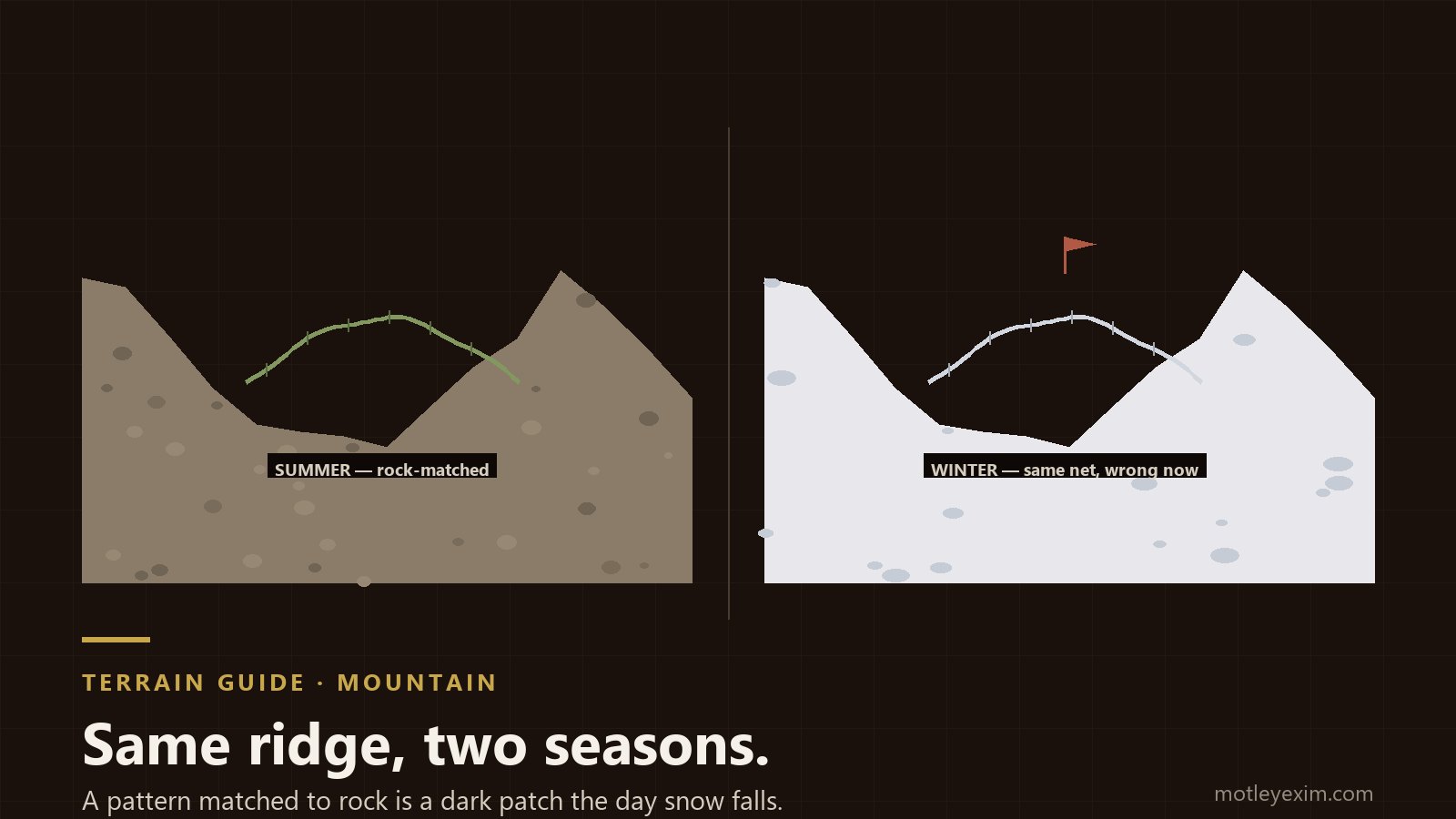
- Snow changes everything. A pattern matched to summer rock is a dark obvious patch the day snow falls, and the reverse when it melts — most positions need a reversible cover or two.
- Thin air carries thermal signatures further and clearer; extreme day-night temperature swings can shift standoff gaps set the night before.
- Wind at altitude is routinely severe and constant — rigging needs more anchor points and hardware rated for sustained load, not a flatland setup.
- Positions are watched from above far more often — the top needs real coverage, not just the sides.
Above the treeline, there is nothing green to match
Camouflage design almost always starts from vegetation: a shade of green, a leaf shape, a density of foliage to disrupt. Mountain terrain above the treeline removes that starting point entirely. The background is bare rock, scree, exposed soil and, depending on season, snow — mineral colour rather than organic green, and hard angular texture rather than the soft irregular shapes foliage produces. A pattern designed around vegetation and simply recoloured grey or brown for "mountain use" keeps the wrong kind of texture even when the colour is close.
The practical answer is the same discipline used for any terrain in this series — desert, arctic, urban — match the actual ground at the actual position, not a generic idea of what mountains look like. Rock colour varies enormously by geology, and a pattern built for grey granite reads wrong against reddish sandstone or pale limestone scree.
Snow changes the problem twice a year
Nowhere else in this series does the background itself change as completely as it does at altitude. Snow reflects visible light and near-infrared far more strongly than bare rock, so a cover colour-matched to summer ground becomes a dark, obvious patch the moment snow settles — and a white winter pattern is equally wrong the moment it melts off. This is not a gradual shift the way a desert position slowly weathers; it can happen over a single night.
Snow cover is also uneven in mountain terrain — it holds in gullies and shaded faces long after ridgelines and south-facing slopes have cleared, producing a patchwork rather than a uniform white background. Matching a patchwork is harder than matching either extreme on its own. The two realistic answers are a reversible or dual-sided cover that presents a different face for each season, or two separate covers held in reserve and swapped as conditions change — asking one fixed pattern to do both jobs is where most mountain camouflage actually fails.
Thin air carries a thermal signature further
Altitude changes thermal physics as much as it changes what things look like. Thinner air scatters and absorbs thermal radiation less than air at sea level, so a heat signature that would be softened on its way to a sensor lower down carries further and reads more clearly through a thermal imager at altitude. Ambient rock and ground temperatures also run colder and more stable than the surrounding air can be in direct sun, which widens the contrast between anything genuinely warm and everything around it.
The extreme day-night swing common at altitude adds a second, more mechanical problem. A standoff gap and rigging set correctly in the cold of night can shift as sun-exposed surfaces expand through the day, closing gaps that thermal concealment depends on. The physics of why that gap matters is covered in our note on how anti-thermal camouflage works; at altitude, the same principle has to survive a much wider temperature range in a single 24-hour cycle.
Wind at altitude does not let up
Exposed ridgelines and high passes see wind loading that routinely exceeds anything a flatland or valley position experiences, and rarely settles for long. A cover that flaps works its anchor points loose over time, and a flapping surface catches light unevenly and moves in a way that stationary terrain never does — motion defeats concealment as reliably as the wrong colour does, sometimes faster, because movement is exactly what the eye and many sensors are built to notice first.
Rigging for a mountain position needs to be planned for the site's actual wind exposure, not a standard valley setup: more anchor points, closer spacing between them, and hardware rated for sustained high load rather than occasional gusts. It is worth treating wind exposure as a sizing input in the same way our guide to sizing and coverage planning treats standoff and overhang — a position that is technically covered but poorly anchored is not a covered position for long.
Mountain terrain is watched from above
Flat terrain is mostly observed from roughly the same level, or from directly overhead by aircraft and satellites — the case covered in our guide to satellite and aerial ISR concealment. Mountain terrain adds a third, very common viewing angle: the next ridge over, or higher ground a few hundred metres up the same slope, which gives an observer a near-vertical look into a position without needing an aircraft at all. That is a genuinely different threat picture from level ground, where the side profile of a covered position is usually what matters most.
A cover designed mainly to break up a side-on silhouette can leave the top of a position essentially uncovered from a ridge one valley over. In mountain terrain, full overhead coverage is not the belt-and-braces addition it can be on flat ground — it is frequently the primary requirement, because there is almost always somewhere higher to look down from.
What to specify for a mountain position
Six answers cover most of what changes at altitude:
- Season and coverage need — bare rock only, snow only, or both (reversible/dual cover, or two separate covers).
- The actual rock and soil colour at the position, not a generic "mountain" palette — geology varies enormously.
- Altitude and temperature range, which drives standoff behaviour and material selection.
- Wind exposure of the site, which decides anchor spacing and rigging hardware.
- Likely viewing angle — whether the position is overlooked from a nearby ridge or higher ground, which decides how much of the top needs full coverage.
- Deployment pattern — left in place through a season, or moved and re-rigged often, which affects weight and packing.
Central Asian and high-altitude terrain is where this comes together in practice — see our page on defence camouflage for Tajikistan for a market where mountain conditions are the norm rather than the exception. For the broader requirement, see how to specify a multispectral camouflage net and the complete guide to camouflage nets.
Frequently Asked Questions
Why is mountain camouflage different from other terrain?
It removes the assumption most camouflage starts from: continuous vegetation. Above the treeline the background is bare rock, scree and snow — mineral colour and hard angular texture, not organic green. Positions are also observed from directly above or higher ground far more often, and the same net may need to work over a bare-rock summer and a snow-covered winter.
Does snow change how a camouflage net performs?
Substantially. Snow reflects visible light and near-infrared far more strongly than bare rock, so a summer-matched pattern reads as a dark obvious patch the day snow falls — and the reverse when it melts. Snow cover is also uneven (gullies vs ridgelines), which is harder to match than a uniform white background. Most positions need a reversible cover or two separate covers, not one pattern for both seasons.
Why does thermal concealment matter more at altitude?
Thinner air scatters and absorbs thermal radiation less, so a heat signature carries further and reads more clearly through a thermal imager. Colder, more stable ground temperatures also widen the contrast against anything warm. The extreme day-night swing common at altitude can shift standoff gaps set correctly the night before as sun-exposed surfaces expand through the day.
How does wind affect camouflage nets in mountain terrain?
Wind loading on exposed ridgelines routinely exceeds a valley or flatland position and rarely lets up. A flapping cover works its anchors loose and catches light unevenly — motion defeats concealment as reliably as the wrong colour. Rigging needs more anchor points, closer spacing, and hardware rated for sustained high load.
Why does overhead cover matter more in the mountains?
Mountain terrain puts more surrounding ground above a position than below it. Ridgelines and higher slopes give a near-vertical view into a position far more often than flat terrain does. A cover built mainly to break up a side silhouette can leave the top essentially uncovered from a ridge one valley over.
What should a mountain position specify when ordering a camouflage net?
Six things: season/coverage need (reversible or two covers); the actual rock and soil colour at the position; altitude and temperature range; wind exposure of the site; likely viewing angle (ridge/overhead); and deployment pattern (fixed vs frequently moved).
Procurement or technical question?
CAMPRO® camouflage, CAM-IRR® paint, fire-suppression systems, and export-compliance support. Our team replies within one business day.
Contact Our Team →