
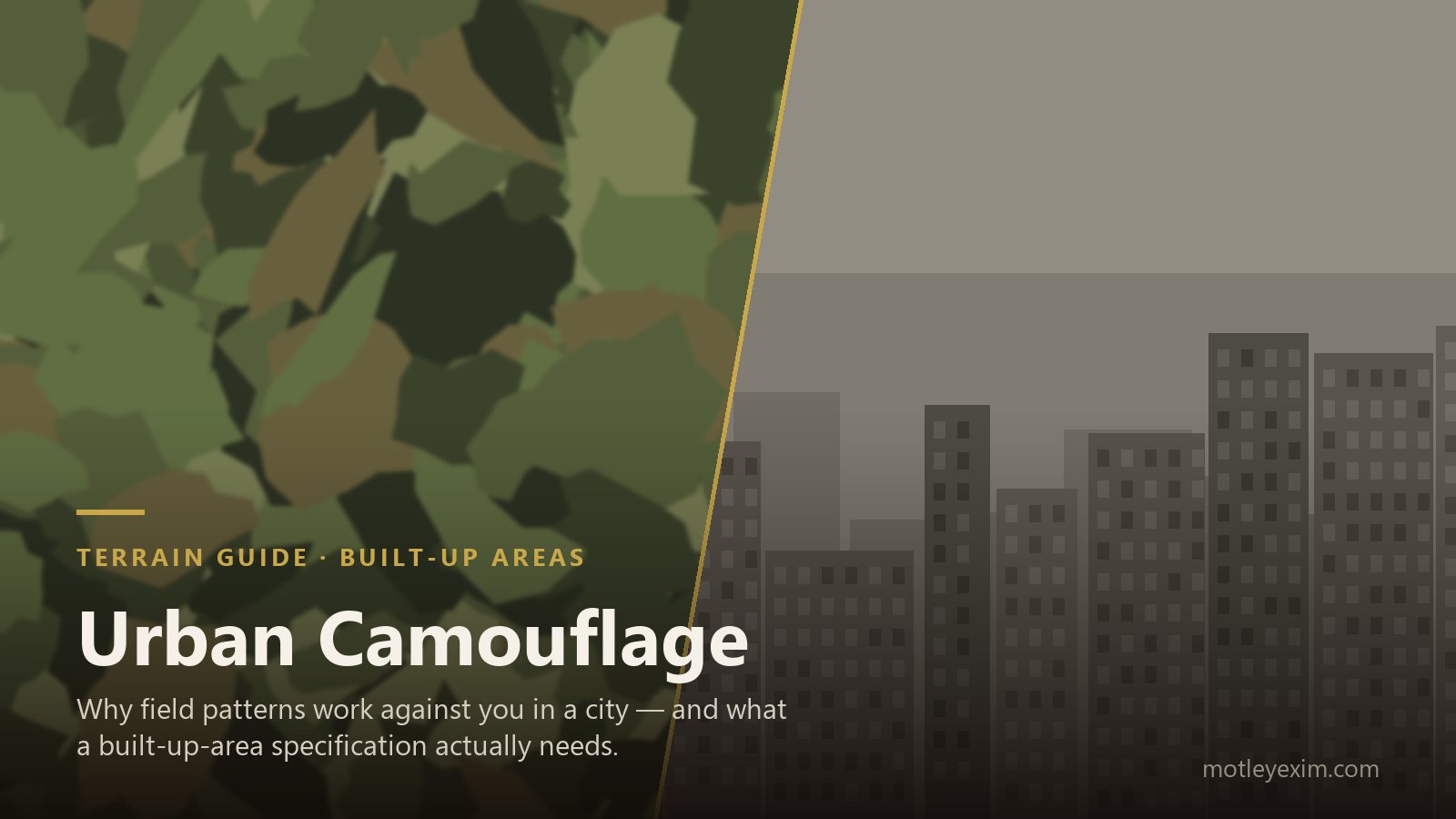
Almost every principle in field camouflage assumes a natural background — irregular shapes, organic colour, foliage that moves, ground that cools evenly after dark. A built-up area breaks all four assumptions at once. Urban concealment is not woodland concealment in a different colour; it is a different problem, with different geometry, different materials, a different thermal background and observers at every elevation. This guide covers what actually changes, and what to specify for it.
TL;DR
- Urban backgrounds are geometric — straight edges, flat planes, right angles. Organic field patterns read as an obvious blob against them.
- The background is man-made: concrete, brick, plaster, glass and dust behave differently from foliage in both the visible and near-infrared bands.
- Masonry stores solar heat and radiates it for hours after sunset, so the urban thermal background is cluttered and uneven — not the clean cold field a thermal imager sees in open terrain.
- Observation comes from every elevation — ground level, upper floors, rooftops, and drones moving between buildings rather than only above them.
- Shadow is deep and hard-edged, which conceals well but also makes any mismatch inside it more obvious.
The background stops being organic
Field camouflage works by imitating disorder. Foliage is irregular, shadow is dappled, edges are broken and nothing in the scene is straight. Disruptive patterns exploit that: they break an outline into shapes the eye reads as background clutter rather than as an object.
A built-up area removes that disorder. The background is made of straight lines, flat planes, right angles and repeating modules — window bays, doorframes, kerbs, parapets. Two things follow. First, an organic blob of woodland pattern is now the only irregular shape in a geometric scene, which is exactly the opposite of what camouflage is supposed to do. Second, the equipment being hidden is often geometric too, and hard straight edges are easier to read against a hard straight background because the eye has clean reference lines to compare against. Concealment in this setting is less about imitating a texture and more about breaking the specific silhouette, which is where three-dimensional garnish and shape disruption matter more than pattern printing. The underlying principles across all terrain still apply — what changes is which of them carries the weight.
Man-made surfaces do not behave like foliage
Colour is the obvious difference: urban finishes sit in the grey, buff and muted-brown range of concrete, brick, plaster and dust rather than the greens of field patterns. But the more important difference is invisible.
Living vegetation has a very distinctive near-infrared signature — it reflects strongly in the NIR, which is why field camouflage is engineered to imitate that behaviour. Masonry, tarmac and rendered surfaces do not. A finish tuned to look and behave like foliage can therefore be correct in daylight colour and still stand out under an image intensifier when it is placed against a concrete wall. Urban finishes have to be matched to the near-infrared behaviour of built surfaces, not borrowed from a field pattern and re-coloured. Our explainer on infrared reflectance in camouflage coatings covers why this band is engineered separately.
The thermal background is cluttered, not clean
In open terrain a thermal imager sees a simple picture: cool, fairly uniform ground, and any warm object on it is obvious. That is what makes emissivity control and standoff so decisive in the field.
A built-up area is thermally noisy. Masonry, concrete and tarmac absorb solar energy through the day and release it for hours after sunset, so surfaces are at widely different temperatures at any given moment — sunlit and shaded walls, a road still warm at midnight, a cool interior doorway. That clutter cuts both ways. It gives more places for a managed signature to blend into, and it can mask a small heat source that would be obvious in a field. But it also means there is no single background temperature to match; the finish has to sit plausibly across a much wider range. And the underlying physics does not change — as covered in our note on emissivity in thermal camouflage, it is still surface behaviour and decoupling from the hot asset that do the work, not simply covering it.
Observers at every elevation
Open-terrain concealment is largely designed against two viewpoints: ground level and overhead. A built-up area adds everything in between. Upper floors, balconies, rooftops and stairwells all provide elevated observation, and each looks down at a different angle. A net that conceals an asset perfectly from ground level may present a completely unbroken top surface to someone three floors up.
Small drones make this sharper still. In open ground a drone observes from above; in an urban canyon it can descend between buildings and look at a position from the side, from an oblique angle, and from close range. That means concealment has to work across many aspects at once rather than being optimised for a frontal or overhead view — and, because those drones increasingly carry thermal sensors, it has to work across bands at each of those angles. Our anti-drone concealment guide covers the sensor side of that threat in more detail.
Shadow, dust and rubble
Urban shadow is deep and hard-edged rather than dappled, because it is cast by solid structures instead of foliage. That is useful: a hard shadow is a genuine concealment resource, and positions are routinely sited to exploit it. The catch is that the eye and the sensor both use those hard edges as reference. Anything inside a shadow that is slightly the wrong tone, or that softens a hard edge where a hard edge should be, becomes noticeable precisely because the surrounding geometry is so regular.
Damaged built-up areas add another variable. Rubble, broken masonry and construction dust change the local colour and texture, often lightening everything with a fine grey-buff layer. A finish matched to clean concrete may sit poorly against dusty rubble and vice versa, which is a practical argument for reversible or terrain-matched options where a unit expects to operate across both.
What to specify for urban use
An urban camouflage requirement should state more than a colour:
- The sensors actually in the threat picture. Optical only, or near-infrared and thermal as well? Is radar in play?
- The real background. Clean concrete, brick, rendered plaster, dust and rubble — these are different backgrounds, not one “urban”.
- The observation angles that matter, including intermediate elevations, not just ground and overhead.
- Whether the position transmits. A site running its own radar or communications needs a radar-transparent design, not an attenuating one.
- Performance after ageing, measured at an accredited laboratory against stated methods — not performance when new. Our note on NABL-accredited testing explains why measured evidence is the dividing line.
Get those right and the system is being specified against the environment it will actually work in. Get them wrong and you have bought a field net in a grey colourway — which, in a built-up area, is close to no concealment at all. For the wider specification process, see how to specify a multispectral camouflage net.
Frequently Asked Questions
Why does woodland camouflage not work in an urban area?
Woodland patterns imitate an irregular, organic background of foliage and dappled shadow. A built-up area is the opposite — hard straight edges, flat planes, right angles and man-made greys and browns. A pattern designed to dissolve into vegetation becomes the only organic shape in a geometric scene, and its near-infrared behaviour, tuned to living foliage, does not match masonry either.
What colours are used for urban camouflage?
Generally the grey, buff and muted-brown range that matches concrete, brick, plaster and dust, rather than the greens of field patterns. But colour alone is not the answer — the near-infrared reflectance of the finish also has to sit close to the built surfaces around it, or a correct-looking grey can still stand out under night vision.
Does thermal camouflage still work in a city?
Yes, but the problem changes shape. Open terrain cools quickly and evenly, so a warm object is obvious. Masonry and tarmac absorb solar heat by day and radiate it for hours after dark, so the urban thermal background is cluttered and uneven. That clutter can help conceal — but it also means the finish must sit plausibly across a much wider range of background temperatures.
Can the same camouflage net be used in urban and rural terrain?
A general-purpose net can be used in both, but it is a compromise in each. Where concealment genuinely matters, terrain-specific finishes perform better, because tone, pattern scale and near-infrared reflectance are all matched to the actual background. Reversible nets are one practical answer where a unit moves between environments.
What makes observation different in built-up areas?
In open terrain the threat is largely from ground level and from above. In a built-up area you are also observed from every intermediate elevation — upper floors, rooftops and stairwells — and small drones can descend between buildings rather than only passing overhead. Concealment has to work from many angles at once.
What should an urban camouflage specification include?
The sensors in the threat picture; the actual built background (concrete, brick, dust, rubble); the observation angles that matter, including intermediate elevations; whether the position transmits, which decides radar-transparent versus attenuating; and signature performance after ageing, measured at an accredited laboratory against stated methods.
Procurement or technical question?
CAMPRO® camouflage, CAM-IRR® paint, fire-suppression systems, and export-compliance support. Our team replies within one business day.
Contact Our Team →