
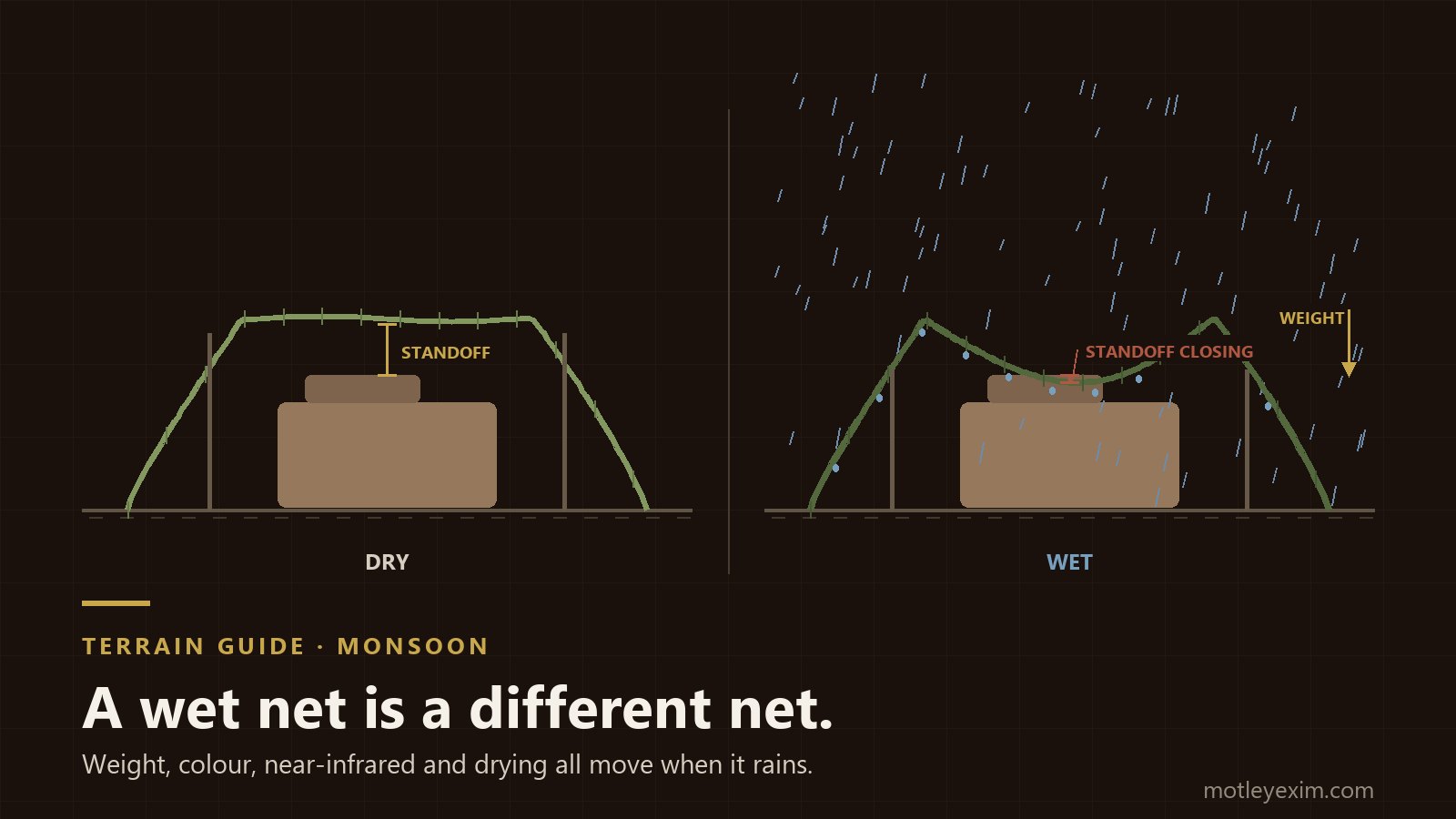
Most camouflage is specified in a dry room, on a dry day, from a dry sample. Then the monsoon arrives and the net that was signed off in April spends August soaked, sagging, darker than its swatch and heavier than its poles were rigged for. A wet net is a different net. This guide sets out what rain and humidity actually change — weight, colour, near-infrared, temperature and service life — and what to write into a requirement so the cover still works in the wettest month, not only the driest.
TL;DR
- A wet net is a different net. Weight, colour, near-infrared reflectance, temperature and lifespan all move when it rains.
- Water is weight — absorbent materials sag, close the standoff gap and overload the rigging. Specify a wet weight, not just a dry one.
- Wet surfaces darken and shift in NIR; the background shifts too. A net that behaves like foliage when wet keeps its match. Smooth sheets go glossy and glint.
- Rain flattens thermal contrast, which helps; a net still drying can run cooler than warming ground, which does not.
- Mould comes from one habit: packing wet. Dry, ventilate, store off the floor — and ask for water-shedding, not waterproof.
A wet net is a different net
Camouflage is almost always evaluated dry. The sample on the desk is dry, the field trial is arranged for a clear day, and the reflectance report describes the material as it left the factory. None of that is wrong; it is simply incomplete for a country where a large part of the year is wet and a large part of the rest is humid. Rain changes five things about a cover at the same time — how much it weighs, how it looks, how it reflects in the near-infrared, how warm it is, and how long it lasts — and a requirement that ignores them is a requirement for the dry season only.
The rest of this guide takes those five in turn. It sits alongside the other terrain guides in this series — desert, arctic and urban — because the monsoon is a terrain of its own: the same ground, transformed for three months.
Weight: what water does to the rigging
Water is weight, and it arrives all at once. A construction built from absorbent fibres or dense coated fabric can hold a substantial fraction of its own dry mass once it is saturated, and garnish — the three-dimensional elements that do the disrupting — traps droplets by design. Every kilogram of that goes onto the poles, the spreaders, the pins and, eventually, the people who have to lift and recover the cover.
The damage is not only to backs. A cover that sags under its own wet weight settles towards whatever is underneath it. That closes the standoff gap that thermal concealment depends on, and can put wet material directly onto hot surfaces where it conducts heat through and becomes the warm object a thermal imager sees. It also flattens the three-dimensional texture into a two-dimensional skin. Open knitted synthetic constructions shed water rather than storing it and gain far less; the practical specification is a wet weight alongside the dry one, and a support system sized for the wet figure. The arithmetic of span and standoff is covered in our note on sizing and coverage planning.
Colour and near-infrared: everything darkens, but not equally
Wet surfaces look darker. That is true of the net and it is true of the ground, the vegetation and the rock around it, so the question is never whether a cover changes when wet but whether it changes in the same way as its background. Materials chosen and finished to behave like foliage across the visible and near-infrared bands tend to track the background as both get wet; materials that only matched dry drift apart from it.
The usual failure is not colour at all. A smooth printed or coated sheet carries a film of water that turns it glossy, and when the cloud breaks that gloss becomes a specular glint — a bright reflection of the sky that no pigment can hide and that reads from a great distance. Garnished, open constructions break the film up into droplets on a textured surface and do not glint in the same way. Because near-infrared cannot be judged by eye, the honest ask is for reflectance data taken wet as well as dry; the bands themselves are explained in our guide to the UV, NIR and thermal spectrum, and the coatings that manage them in infrared-reflectance coatings.
Thermal: rain flattens contrast, then the sun comes out
Rain and heavy cloud are, on balance, a gift to thermal concealment. Everything in the scene is pulled towards the same temperature: no direct sun to heat surfaces unevenly, water carrying heat away from anything warm, and a sky that does not offer a cold background for warm objects to stand against. Contrast collapses and with it the imager’s ability to separate an object from its surroundings.
The difficulty comes afterwards. When the sun returns, dry ground and rock warm quickly while a wet cover keeps cooling itself by evaporation, so for a period the net can read colder than the ground it is meant to resemble — a cold-contrast target instead of a warm one. Panels dry at different rates, which produces a patchy thermal texture; that patchiness is broadly helpful, because natural ground dries unevenly too. What is not helpful is a saturated cover resting on a hot engine deck. The mechanism is set out in how anti-thermal camouflage works; the monsoon does not change the principle, it changes the timing.
Mould, mildew and the humid-storage problem
Synthetic fibres do not rot. That is often heard as "synthetic nets do not get mould", which is not the same thing. Mould grows on the soil, dust and organic matter that a season in the field leaves on any surface, and it needs only damp and stillness to do it. Natural-fibre garnish and cotton-blend stitching can rot outright. The results are discolouration, odour, weakened seams and, on coated materials, coatings that lift and delaminate.
Almost all of this damage is caused by one habit: packing the cover while it is still wet, rolled tight in a bag, and leaving it there. A week is enough. The remedy is discipline rather than chemistry — dry before packing, store off the floor in a space with air moving through it, never stack bags so the bottom ones cannot breathe, and open anything that was packed in a hurry at the first dry spell. Our guide to care, maintenance and service life covers the routine; the monsoon simply makes it non-negotiable.
What to specify for monsoon and tropical service
Most of the above can be designed out at the requirement stage. Seven lines in a specification do most of the work:
- Low-absorption, water-shedding construction — open knitted synthetic base that drains, not a waterproof skin that pools.
- Wet weight declared alongside dry weight, and the support system sized for it.
- Synthetic garnish and stitching throughout; no natural fibre anywhere in the assembly.
- Reflectance checked wet and dry, across visible and near-infrared, against the terrain the cover will actually serve in.
- Matte, textured finish that does not glint under a water film.
- UV-stabilised materials — humidity and strong sun together age coatings faster than either alone.
- Fast drying and a storage instruction written into the delivery, so the season does not end with a written-off cover.
Our CAMPRO® constructions are built for exactly these conditions — synthetic, low-absorption and specified to be assessed wet as well as dry — and the material choices behind that are set out in materials, durability and weather resistance. For the wider requirement see how to specify a multispectral camouflage net, and the complete guide to camouflage nets for the principles underneath all of it.
Frequently Asked Questions
Does rain affect how well a camouflage net works?
Yes, in several ways at once. Water adds weight, which makes the cover sag and can close the standoff gap thermal concealment depends on. Wet surfaces darken and shift in near-infrared, so the match to the background changes. Rain and cloud flatten thermal contrast across the scene, which helps; a net still drying can read cooler than ground that has already warmed, which does not. A net built for wet service keeps these effects small and predictable.
How much heavier does a camouflage net get when it is wet?
It depends almost entirely on the material. Absorbent fibres and dense coated fabrics can hold a large fraction of their own dry weight in water; open knitted synthetic constructions shed water and gain far less. Ask the supplier for a wet weight as well as a dry weight, and size poles, spreaders and pins for the wet figure.
Does a wet camouflage net still match the background in near-infrared?
Wet surfaces darken and their reflectance shifts — and so does the background. A net whose materials behave like foliage when wet keeps its match; one that only matched dry drifts. The common failure is gloss: a film of water on a smooth printed sheet becomes a specular glint under a break in the cloud. Ask for reflectance checked wet as well as dry.
Can camouflage nets get mould or mildew?
Any surface that stays damp and dirty can, including synthetic ones — the growth feeds on soil and organic matter, not the fibre. Natural-fibre garnish and cotton threads can rot outright. Discolouration, odour, weakened seams and lifted coatings are the result, and almost all of it comes from packing a net wet. Dry before packing, store off the floor, ventilate.
Is a waterproof camouflage net a good idea for the monsoon?
Usually not. A waterproof sheet pools water, blocks the airflow that keeps the cover from heating, and turns glossy when wet. What a monsoon cover needs is a water-shedding, low-absorption, open construction that drains and dries fast, with garnish that breaks up the surface. Shedding, not proofing, is the specification.
How should camouflage nets be stored during the monsoon?
Dry them before they go into a bag — hung or spread, never rolled tight while damp. Store off the floor on racks in a ventilated space, do not stack bags so the bottom ones cannot breathe, and inspect after the first dry spell for odour, spotting and stiffness. Ten minutes of drying discipline saves a cover that would otherwise be written off at season’s end.
Procurement or technical question?
CAMPRO® camouflage, CAM-IRR® paint, fire-suppression systems, and export-compliance support. Our team replies within one business day.
Contact Our Team →