
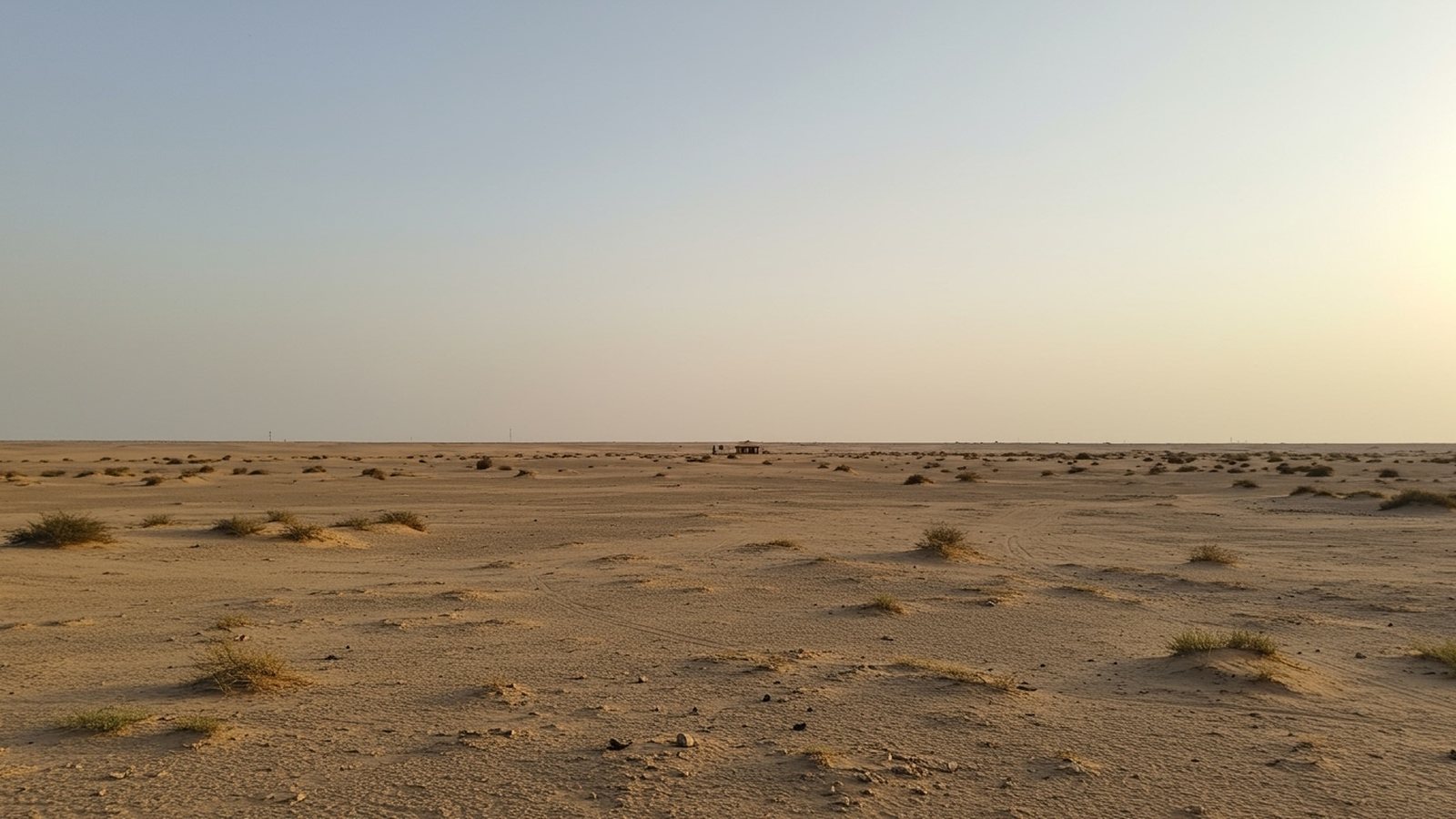
Open desert is one of the hardest places on earth to hide. There is little natural cover to break an outline, sightlines run for kilometres, and the sun turns every asset into a heat source that a thermal imager can read long after dark. A desert camouflage net has to solve a different problem from a woodland or arctic one — and a net matched to the wrong terrain fails across every sensor at once. This guide explains what makes arid environments distinct, and what a desert net actually has to manage.
TL;DR
- Desert terrain offers almost no natural cover and very long lines of sight, so breaking an asset’s outline and shadow matters more than in cluttered ground.
- The dominant problem is thermal: assets heat-soak under intense sun by day and glow against cold desert nights, so emissivity management and standoff are decisive.
- Colour and near-infrared must match sand, scrub or rocky backgrounds — not one generic ‘desert tan’; arid terrain varies widely.
- Materials must survive extreme ultraviolet, wind-blown sand abrasion and large day-night temperature swings without losing signature performance.
- A multi-spectral net engineered for arid terrain manages the visible, near-infrared and thermal bands together; a printed sand-coloured mesh manages only the first.
Why the desert is a different concealment problem
Most camouflage doctrine is written around cover — woodland, scrub, urban clutter — where there is something in the background to blend into. Arid and desert terrain removes that advantage. The ground is open and uniform, natural cover is sparse, and an observer or sensor can see for kilometres. In that setting a net cannot rely on a busy background to hide in; it has to break up the asset’s own outline, shape and shadow, and do so from every direction, including from above. For the technical foundations that apply across terrains, our guide to the camouflage net covers each sensor band in turn.
Heat is the dominant signature in arid terrain
The defining feature of the desert is heat, and it works against concealment in two ways. By day, intense solar load heats vehicles, shelters and equipment far above the surrounding ground, so a thermal imager sees a bright object against a cooler background. By night, the desert surface cools quickly while an asset — an engine, a generator, an occupied shelter — stays warm, so the same object now glows against a cold background. A sand-coloured mesh does nothing about either case.
Managing the thermal band is therefore the decisive requirement for a desert net. Two mechanisms matter: controlling the net’s surface emissivity so it reads closer to the terrain rather than as an anomaly, and physically decoupling the net from the hot asset with standoff and a three-dimensional structure so trapped heat does not simply reappear on the outer surface. Our explainer on emissivity in thermal camouflage covers why surface behaviour, not temperature alone, sets what the imager sees.
Matching sand, scrub and rock — not one ‘desert tan’
‘Desert’ is not a single colour. Arid terrain ranges from pale dune sand to reddish desert, dark gravel plains and sparse scrub, and each has its own tone and its own near-infrared reflectance. A net printed in a generic tan may look right to the eye in one setting and wrong in another, and near-infrared mismatch can make it stand out under night-vision devices even when the daylight colour looks correct.
A defence-grade desert net addresses this on two levels: a visible pattern and tone matched to the specific background, and controlled near-infrared reflectance so the net does not betray itself to an image intensifier. Disruptive shaping and garnish break up the hard geometric lines of vehicles and equipment, which stand out sharply against smooth desert ground.
Long sightlines, radar and the view from above
Open terrain also means long radar sightlines and few obstructions, so a radar-managed net can matter more here than in cluttered ground. Where the position operates its own radar or communications, a radar-transparent net conceals the asset optically and thermally without blinding its own emitters; where the radar return itself must be reduced, a high-attenuation net is used instead. The right choice depends on whether the position transmits — a distinction covered in our note on radar-transparent camouflage for operating assets.
Because desert positions are frequently watched from the air, overhead concealment is as important as the ground view. A net has to defeat the same sensors — visual, near-infrared and thermal — when seen from above, which is exactly the aspect where an unbroken outline on open ground is most exposed.
Surviving sun, sand and temperature swing
A desert net has to keep working after the environment has worked on it. Sustained ultraviolet degrades unprotected materials and fades colour; wind-blown sand abrades surfaces; and the large day-night temperature swing stresses coatings and fabric repeatedly. If a net’s signature performance is only valid when new, it is not fit for arid service. Defence-grade nets are specified to hold their visible, near-infrared and thermal behaviour after ageing, and to remain flame-retardant and mechanically sound — properties a commercial shade net does not claim. Our note on NABL-accredited testing explains why measured evidence, not adjectives, is what separates the two.
Choosing a desert camouflage net: a checklist
A few questions separate a genuine arid-terrain system from a sand-coloured mesh:
- Which bands does it manage? Visible only, or near-infrared and thermal as well? In the desert, thermal is not optional.
- Is the colour and near-infrared matched to the actual background — dune, scrub, or rocky plain — rather than a single generic tan?
- Does the position transmit? If it runs its own radar or comms, it needs a radar-transparent net, not a high-attenuation one.
- Does performance survive ageing? Ultraviolet, abrasion and heat should not erase the signature; ask for performance after ageing, not just when new.
- Is there test evidence? Accredited-laboratory measurement against stated methods, with references to standards such as MIL-PRF-53134 and NATO STANAG test methods.
Get these right and the net does its job across the whole arid environment. Get them wrong and an expensive asset stays visible on open ground to exactly the sensors that matter. For the full specification process, see how to specify a multispectral camouflage net.
Frequently Asked Questions
What makes desert camouflage different from woodland or jungle camouflage?
Desert terrain offers almost no natural cover and very long sightlines, so a net must break up an asset’s own outline and shadow rather than blend into a busy background. Heat is also dominant — assets heat-soak under the sun by day and glow against cold ground by night — so thermal management matters more than in cluttered terrain.
Does a desert camouflage net need to defeat thermal imaging?
Yes. Thermal is the dominant signature in arid environments, because assets are much hotter or cooler than the open desert around them. A sand-coloured mesh does nothing in the thermal band; a multi-spectral desert net manages surface emissivity and decouples the net from the hot asset.
Is one generic desert tan colour enough for all arid terrain?
No. Arid terrain ranges from pale dune sand to reddish desert, gravel plains and sparse scrub, each with its own tone and near-infrared reflectance. A net matched to the specific background performs; a single generic tan can look right in one setting and stand out in another, especially under night vision.
Can a desert net conceal a position that uses its own radar?
Yes, with the right type. A radar-transparent net hides the asset optically and thermally without blinding its own radar or communications, while a high-attenuation net is used where the radar return itself must be reduced. The choice depends on whether the position transmits.
How long does a desert camouflage net last in service?
A defence-grade net is specified to hold its signature and strength after ultraviolet exposure, sand abrasion and repeated day-night temperature swings. Service life depends on the material specification and testing, which is why measured performance after ageing, not just when new, is what to ask for.
Where can I buy a desert camouflage net in India?
From a defence-grade manufacturer that can state the bands its nets address and provide test evidence for arid terrain. Motley Exim Co. (CAMPRO®) manufactures multi-spectral, radar-transparent and high-attenuation camouflage nets in India; you can request specifications through the site.
Procurement or technical question?
CAMPRO® camouflage, CAM-IRR® paint, fire-suppression systems, and export-compliance support. Our team replies within one business day.
Contact Our Team →