
Most camouflage guidance treats jungle as a single shade of green to match. Real jungle is layered, alive and in constant motion — canopy that already blocks most of the sky, foliage with a near-infrared signature no synthetic dye naturally replicates, and humidity that doesn't just dampen material but grows on it. This closes out our terrain series alongside desert, arctic, urban, monsoon and mountain — and arguably the one terrain where the background itself does the most to defeat a pattern that was only ever designed to fool the eye.
TL;DR
- No single green. Canopy layers and dappled light mean a pattern needs tonal range, not one uniform shade.
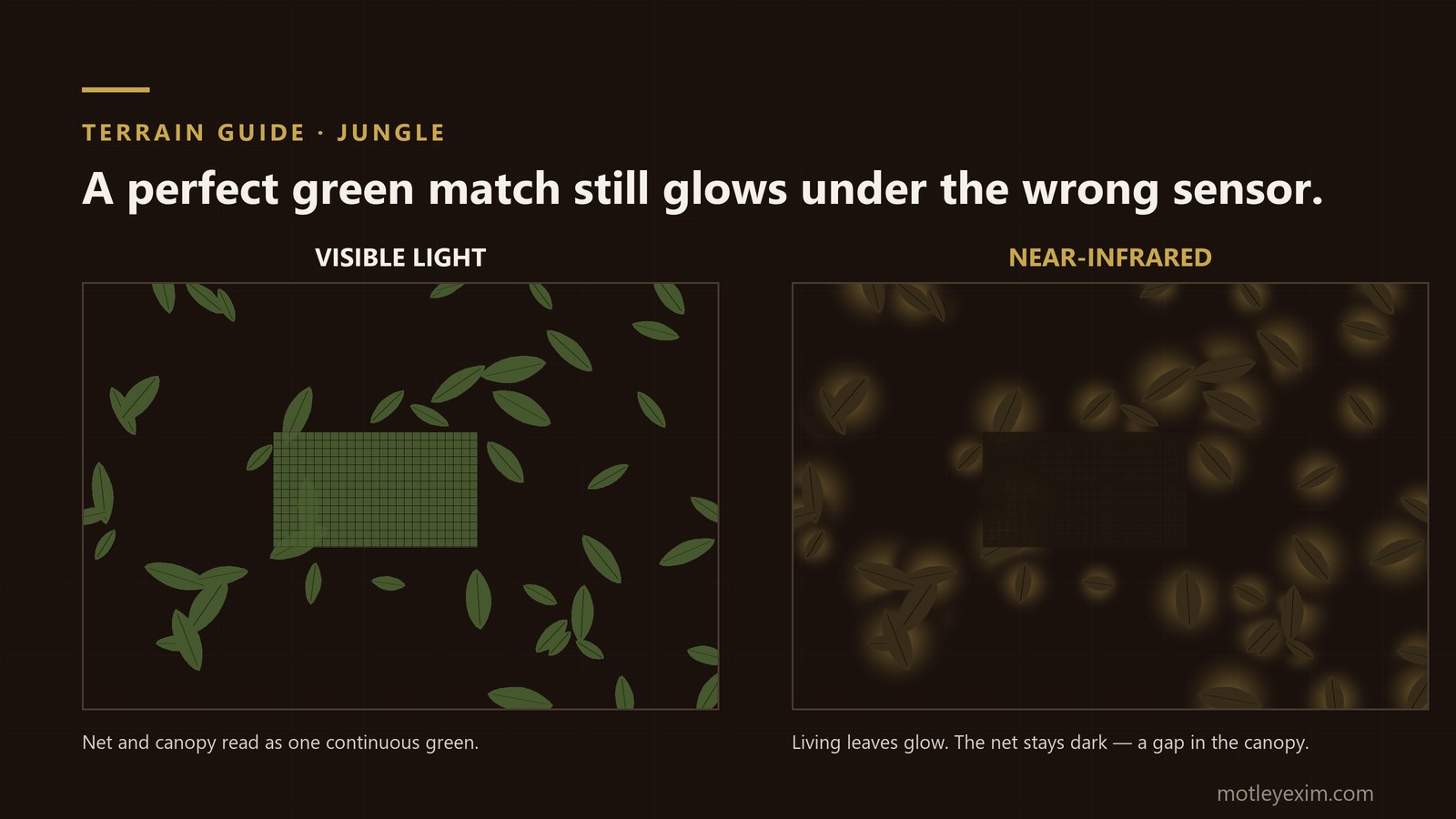
- The chlorophyll problem. Living leaves have a near-infrared signature dyed cloth doesn't naturally match — a visually perfect net can still glow under night vision.
- The highest sustained humidity of any terrain in this series — mould-resistance is default, and long-dwell nets should expect real plant growth through them.
- The one terrain where the environment helps against overhead observation — the risk is an unnatural gap in the canopy, not insufficient cover.
- Movement has to match the canopy layer's natural wind-rustle, or the net itself becomes the signature.
Jungle is not one shade of green
Camouflage design for jungle terrain usually starts and ends with picking a green. Real jungle offers no single green to pick. Canopy structure runs in layers — emergent trees breaking above the main canopy, the closed canopy itself, understory shrubs and vines below that, and a shaded floor beneath all of it — and each layer catches a different amount and colour of light. Sunlight breaks through gaps unpredictably, so the same patch of ground can be bright yellow-green one moment and near-black shadow minutes later as the light shifts. A pattern built around one uniform shade is wrong for most of the terrain, most of the time.
The fix is the same discipline this series has insisted on for every other terrain — desert, arctic, urban — match the actual position, not a generic idea of what jungle looks like. Jungle adds a layering problem the others don't: a pattern needs enough tonal range within itself to survive moving between deep shade and a sunlit gap without becoming the brightest or the darkest thing in the frame either way.
The chlorophyll problem: why living leaves don't look like dyed cloth
A pattern can be a perfect visible-colour match to the eye and still fail completely under night vision or a near-infrared sensor, because living leaves don't just look green — they behave differently from dyed fabric once you move past the visible band. Chlorophyll and the internal cell structure of a living leaf produce a sharp jump in reflectance right past visible red into near-infrared, a transition sometimes called the "red edge" (our spectrum explainer covers the general physics). Ordinary dyed synthetic material has no equivalent internal structure, so it typically does not reproduce that jump — a net that vanishes to the naked eye can still read as a flat, dead patch next to genuinely living foliage the moment a sensor looks past visible light.
Correcting for this needs a deliberate IR-reflective treatment engineered to mimic the reflectance curve of living foliage, not a visible-light dye recipe extended by assumption into bands nobody checked. This is the single most jungle-specific material requirement in the whole terrain series — nowhere else does the "correct" background so precisely defeat a colour-only approach.
Humidity does more than dampen — things grow on the net
Our monsoon guide covers what sustained wetness does to weight and drying time in general. Jungle adds to that rather than repeating it: high humidity and warmth persist together, near-continuously, for the material's entire deployed life rather than one season — close to ideal conditions for mould and fungal growth on the material itself.
On long-dwell positions, actual vegetation can go further than growing near a net — vines and climbing plants can grow into and through one left in place for weeks. In one sense that is free additional concealment nobody planned for; it also changes the net's real pattern in unplanned ways and can strain or distort its structure over time. Jungle-rated material needs mould and fungal-resistant treatment as a default, and long-dwell deployments should expect some organic growth rather than being caught out by it.
The one terrain where the environment helps against overhead observation
Our mountain guide covers a position exposed from above with little natural help, and the same is true of most open terrain watched by satellite and aerial ISR. Jungle is the reverse case: dense, multi-layer canopy already blocks most of a straight-down look before any camouflage is added at all.
The real risk here isn't insufficient cover the way it is elsewhere — it's an unnatural discontinuity. A straight-edged tarp, a colour that doesn't match its immediate canopy layer, or a gap cut for movement all read as a break in an otherwise unbroken green ceiling. Concealment work in jungle canopy is closer to "don't create a flaw in what's already there" than "build cover from nothing."
Wind moves every leaf — a net has to move the same way
Wind keeps real foliage in near-constant motion, so rustling movement is the ambient baseline in jungle terrain, not stillness. A net that's too rigid stays motionless while everything around it moves; a net that's too light flutters in a way heavy broadleaf jungle foliage never does. Either mismatch reads as motion where none is expected, or as unnatural stillness where motion is expected — and a sensor or a trained eye notices a movement mismatch as fast as it notices the wrong colour, sometimes faster.
Material weight and drape need to be matched to how the specific canopy layer around a position actually moves, not specified as generically "flexible." Our guide to net materials and durability covers how weight and weave affect this beyond jungle terrain specifically.
What to specify for a jungle or woodland position
Six answers cover most of what changes under canopy:
- Actual local foliage colour and canopy layer — emergent, closed canopy, or understory — not a generic "jungle green."
- IR-reflective treatment matched to living-leaf near-infrared behaviour, not a visible-light dye extended by assumption.
- Mould and fungal-resistant treatment as standard, given sustained humidity rather than seasonal dampness.
- Position relative to the canopy ceiling, so cover doesn't create a visible gap or straight edge from above.
- Material weight and drape suited to how the surrounding canopy layer naturally moves in wind.
- Expected dwell time — long-duration positions need stronger growth-resistance than short-duration ones.
Dense forest and tropical terrain is where this comes together in practice — see our page on defence camouflage for Vietnam for a market where jungle conditions are the norm. For the broader requirement, see how to specify a multispectral camouflage net and the complete guide to camouflage nets.
Frequently Asked Questions
Why is jungle camouflage harder than other terrain?
Because the background is alive. Dense canopy has no single shade of green — light falls in patches through several layers of foliage, each catching a different tone — and unlike dyed fabric, living leaves have a distinct near-infrared reflectance jump caused by chlorophyll. A pattern that matches the visible colour perfectly can still stand out sharply under night vision or NIR imaging if that curve isn't replicated.
What is the chlorophyll problem in jungle camouflage?
Living plant cells reflect near-infrared light far more strongly than they reflect visible red light — a sharp transition known as the red edge, caused by chlorophyll and internal leaf structure. Ordinary dyed synthetic material does not reproduce this jump: it can look identically green to the eye and still read as a flat, dead patch under a night-vision device next to genuinely living foliage. Jungle-rated netting needs an IR-reflective treatment engineered to mimic that living-leaf curve, not just a visible-light colour match.
Does humidity damage camouflage nets in jungle conditions?
Jungle humidity does more than the general dampness covered in wet-climate guidance — sustained high humidity and warmth together are close to ideal conditions for mould and fungal growth on the material itself, and on a position left in place for weeks, actual vines and climbing plants can grow through a net, changing its pattern and potentially its structure. Jungle-rated material needs mould and fungal-resistant treatment as standard, not an optional upgrade.
Does jungle canopy help or hurt concealment from the air?
It genuinely helps — jungle is different from most other terrain in this series here. Multi-layer canopy already blocks a large share of straight-down aerial and satellite observation before any camouflage is added. The task shifts from building overhead cover from nothing to not creating an unnatural gap or colour break in the canopy that a drone or aircraft would notice against an otherwise unbroken green ceiling.
Why does a net's movement matter as much as its colour in jungle terrain?
Wind constantly moves real foliage, so rustling motion is the ambient baseline in jungle terrain, not stillness. A net that's too rigid stays motionless while everything around it moves; a net that's too light flutters in a way heavy jungle leaves do not — either mismatch reads as motion where none is expected, which draws attention as reliably as a wrong colour.
What should a jungle or woodland position specify when ordering a camouflage net?
Six things: the actual local foliage colour and canopy layer, not a generic jungle green; IR-reflective treatment matched to living-leaf near-infrared behaviour; mould and fungal-resistant treatment; how the position sits relative to the canopy ceiling; material weight and drape suited to natural wind movement; and expected dwell time.
Procurement or technical question?
CAMPRO® camouflage, CAM-IRR® paint, fire-suppression systems, and export-compliance support. Our team replies within one business day.
Contact Our Team →