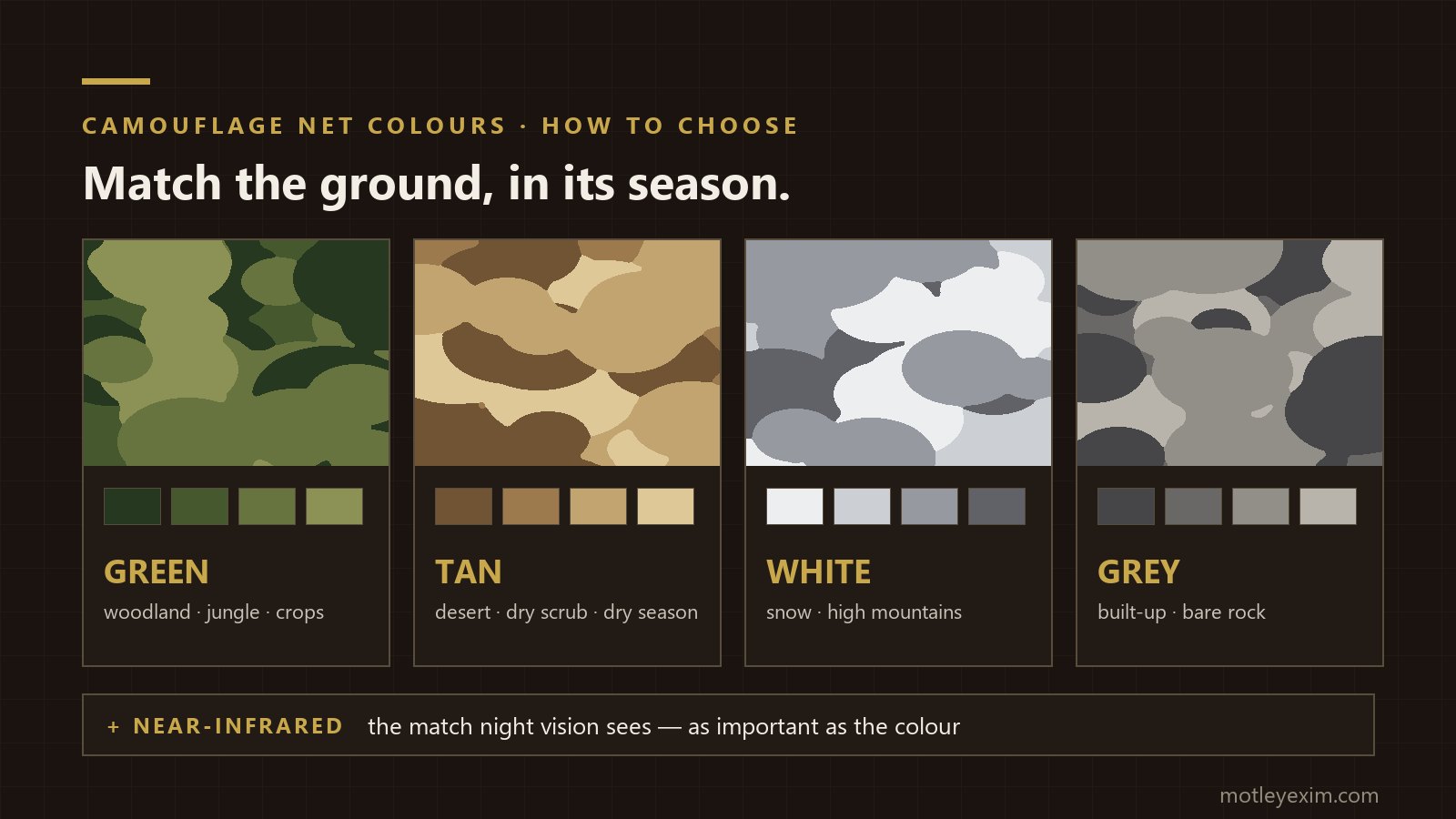
The right colour for a camouflage net is the colour of the ground it will sit on, in the season it will be used. Green for woodland, jungle and crops; tan and brown for desert and dry scrub; white broken with grey for snow; greys for built-up areas and bare rock. This guide explains how to choose among them, why a pattern of several shades works better than one flat colour, and why the colour you cannot see — near-infrared — has to match as well.
TL;DR
- Match the ground, not the catalogue. Photographs of the real terrain tell a manufacturer more than a colour name.
- Green, tan, white and grey are families of shades, not single colours.
- A pattern of several shades breaks up outline better than one flat colour.
- The season changes the ground; a reversible net carries two colour schemes.
- The near-infrared match matters as much as the colour — night vision sees it.
Start from the ground, not the catalogue
A colour name on a quotation — “green”, “desert”, “snow” — says very little. The ground a net has to disappear into is never one colour; it is a mix of tones, light and shadow that changes with the season and the time of day. The most useful thing a buyer can send a manufacturer is a set of photographs of the actual terrain, taken in the season the net will be used, and, if possible, samples of the soil and vegetation.
From those, the colours are chosen as a family: a darker shade, a middle shade and a lighter one, arranged in a pattern. This guide covers the four families most nets are made in. For how each terrain behaves beyond colour — heat, humidity, sightlines, the view from above — our terrain guides go further, and our guide to camouflage netting types covers construction and the bands a net is built for.
Green camouflage netting: woodland, jungle and crops
Green is the colour most nets are made in, because so much ground is vegetated for most of the year. But green terrain is not one shade. Dense forest and jungle are dark, with deep shadow under the canopy; open woodland and scrub are olive and mixed; grassland and crops are lighter and change through the year. A green camouflage net for a forest edge and one for open farmland should not be the same net.
Green is also where the hidden part of colour matters most, because living leaves behave very differently from dyed cloth outside the visible band — more on that below, and in depth in our guide to camouflage in jungle and woodland terrain.
Tan, sand and brown: desert, dry scrub and the dry season
Arid ground ranges from pale dune sand to reddish earth, dark gravel and sparse dry scrub, so “desert tan” on its own is rarely enough. A net that looks right on pale sand looks too light on gravel and too uniform among scrub. Tans and browns also matter outside the desert: in the dry season, grassland and fields that were green turn straw and brown, and a green net left out on them stands out.
Our guide to the desert camouflage net covers the rest of the arid-terrain problem, where heat, not colour, is often the biggest signature.
White and grey: snow and high mountains
A snow camouflage net is rarely plain white. Snow-covered ground almost always shows something else — rock, shadow, bare branches, tracks, the dark line of a treeline — and a solid white net reads as a flat, bright shape against it. White broken with greys matches better. In partial snow and through the thaw, the ground is more grey and brown than white, and the net should follow.
Above the snowline, bare rock, scree and barren mountainside are greys and browns rather than white. Our guide to the arctic camouflage net for cold climates covers the cold-weather side of the problem.
Grey and urban tones
Built-up areas are made of concrete, brick, plaster, asphalt and dust: greys, off-whites and dull browns arranged in straight lines and hard shadows. A field pattern in woodland green becomes the only organic shape in a geometric scene. Urban colours are a family of their own, and so is how they behave beyond the visible band; our guide to urban camouflage in built-up areas covers both.
Several shades in a pattern beat one flat colour
Even the right colour, laid out as one flat sheet, gives the eye a clean edge and an even surface — two things nature rarely has. A disruptive pattern of several shades breaks the outline of what is underneath and imitates the patchy light and shadow of the background. A three-dimensional surface goes further, adding real shadow to the pattern; our three-dimensional multispectral camouflage net is built that way. A matte finish matters too: shine gives away an object long before its colour does.
When the ground changes: seasons and reversible nets
The same position can be green in one season, brown in the next and white in winter. Rather than carrying a second net, a reversible net carries a different colour scheme on each face. On our woven reversible camouflage net and reversible multispectral net, typical pairings are jungle and plain green with desert and semi-desert tan, or snow and barren-mountain white with high-altitude rock or scree. When the ground changes, the crew turns the net over.
The colour you cannot see: near-infrared
Night-vision devices and many surveillance cameras see near-infrared light, just beyond the red end of what the eye sees. Living leaves reflect a great deal of it; ordinary green dye reflects far less. So a green net that matches foliage perfectly in daylight can look dark and out of place through an image intensifier — the most common way a cheap net gives itself away. The same is true of tan against sand and grey against concrete: every background has its own near-infrared behaviour, and the net’s colours have to be made to match it, not just its visible shade. Our explainer on the UV, NIR and TIR spectrum covers the physics.
This is the same logic as infrared-reflective paint for vehicles and equipment, such as our CAM-IRR® NIR-reflective paint: the colour and its near-infrared behaviour are engineered together. Visible colour alone does not decide how a net looks on a thermal imager either; that depends on the materials and construction, which is why a multispectral net is specified band by band.
How to specify the colour of a camouflage net
- Photographs of the real terrain, in each season the net will be used, and soil or vegetation samples if possible.
- The colour family and pattern — green, tan, white or grey — and whether one face is enough or a reversible net is needed.
- Near-infrared matching to the same background, stated and tested, not assumed.
- A matte finish, and whether a three-dimensional surface is wanted.
- Colour and near-infrared results after ageing, since a net that fades turns lighter and flatter than the ground.
CAMPRO® camouflage nets are manufactured in India with colour and near-infrared matched to the terrain specified, on inherently flame-retardant fabric, with NABL-accredited lab test reports available on request; defence exports are subject to India’s SCOMET export-control framework. The checklist in how to specify a multispectral camouflage net covers everything beyond colour. For the wider picture, see the complete guide to camouflage nets.
Frequently Asked Questions
What is the best colour for a camouflage net?
There is no single best colour. The right colour is the one the ground around the position already has, in the season the net will be used. Green suits woodland, jungle and crops; tan and brown suit desert, dry scrub and dry-season ground; white with grey suits snow; greys suit built-up areas and bare rock. Send photographs of the actual terrain and match to those, not to a catalogue name.
Is green camouflage netting good for every terrain?
No. Green is the most common choice because so much ground is vegetated for much of the year, but a green net on sand, dry grass, snow or concrete becomes the most visible object in the scene. Even in green terrain, the shade matters: dark forest greens, olive and the lighter greens of grass and crops are different matches.
What colour camouflage net should be used in snow?
Usually white broken with greys, not plain white. Snow-covered ground almost always shows rock, shadow, bare branches or tracks, and a solid white net reads as a flat, bright shape against them. In partial snow or the thaw, a pattern with more grey and brown matches better than a mostly white one.
Why does a green camouflage net show up under night vision?
Because night-vision devices see near-infrared light, and living leaves reflect a lot of it, while ordinary green dye does not. A net can match foliage perfectly to the eye and still look dark and out of place through an image intensifier. A defence-grade net is made to match the near-infrared behaviour of its background as well as its colour.
Can one camouflage net cover two seasons or terrains?
Yes, a reversible net carries a different pattern on each face. One face might be jungle and plain green and the other desert and semi-desert tan, or one snow and barren-mountain white and the other high-altitude rock or scree. The crew turns the net over when the ground changes instead of carrying a second net.
Do camouflage net colours fade?
Every coloured fabric changes in strong sunlight over time, and a net that fades becomes lighter and flatter than the ground around it. The near-infrared match can drift too, without any visible sign. Ask for colour and near-infrared results after ageing, not only on a new sample.
Procurement or technical question?
CAMPRO® camouflage, CAM-IRR® paint, fire-suppression systems, and export-compliance support. Our team replies within one business day.
Contact Our Team →