
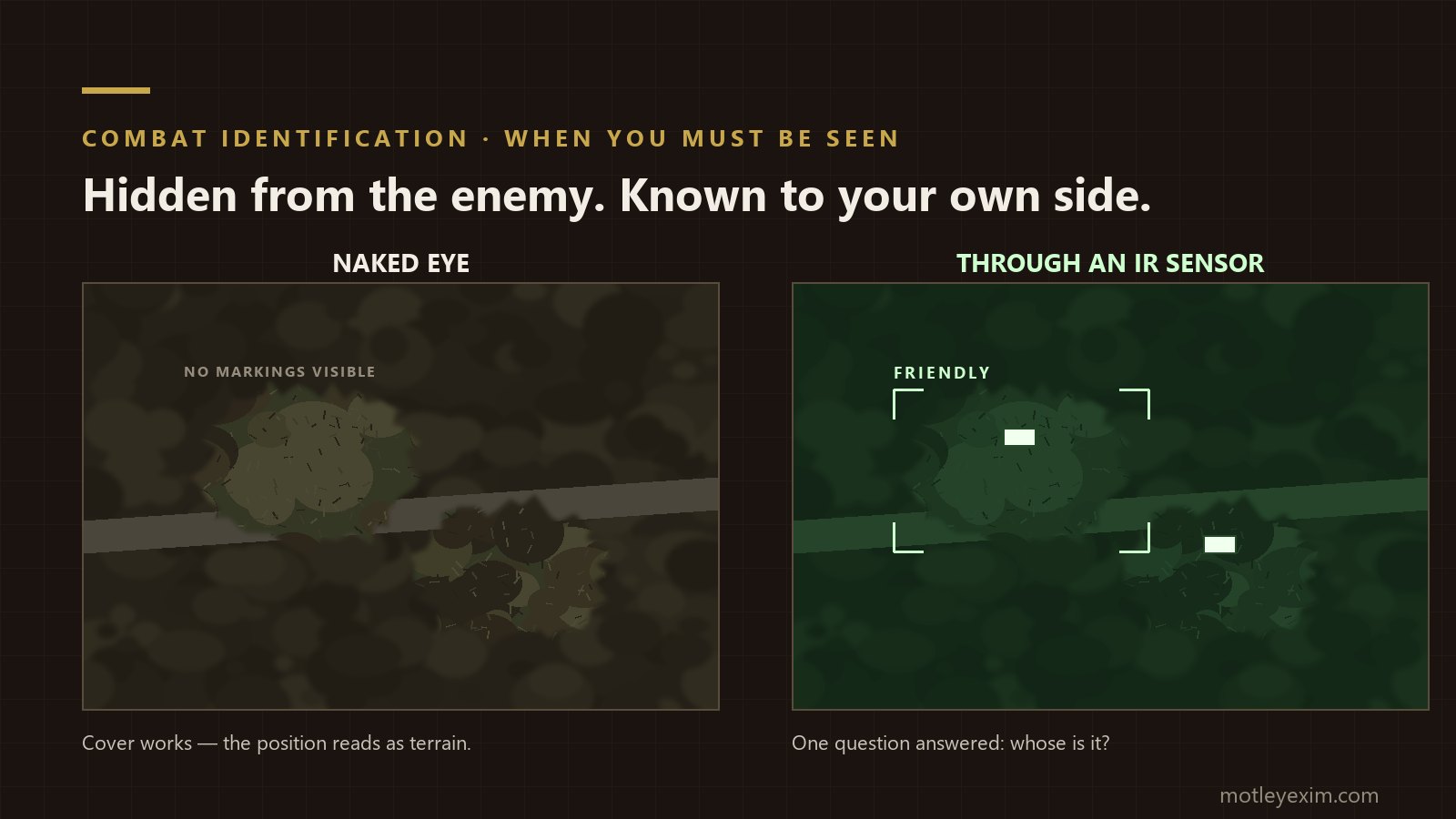
Camouflage is about not being seen. Combat identification is the opposite job: when a friendly aircraft, drone operator or vehicle crew is looking, the position has to read as yours, quickly and without doubt. Those two requirements pull against each other, and the answer is not to weaken the concealment. It is to control exactly what is visible, in which band, and for how long. This guide follows on from camouflage and concealment doctrine and looks at the moment when being seen is the requirement.
TL;DR
- Concealment and identification are opposite jobs — cover that defeats an adversary's sensors defeats friendly ones too.
- The sensor decides the marker: what reads by eye in daylight can be invisible through night vision, and a night-vision marker can mean nothing on a thermal image.
- Anything readable by one class of sensor is readable by anyone holding that class of sensor.
- Timing and rotation matter as much as the marker — shown when needed, changed over time, not left on permanently.
- Markings must be removable and must not undo the multispectral behaviour of the cover underneath.
Two jobs that pull in opposite directions
Every concealment decision has a second half that is easy to forget. A position that has been properly hidden has lost the things that make it recognisable — outline, colour, pattern, heat and movement. That is the whole point against an adversary. The difficulty is that a sensor does not know who is holding it, so the same cover that defeats hostile observation also defeats a friendly aircraft on approach, a friendly drone feed and a friendly vehicle crew moving up at night.
So identification has to be added back deliberately, in a controlled way, rather than left to chance or to the assumption that someone will recognise a familiar shape. The practical goal is narrow: show one thing, to one audience, for as long as the recognition task needs and no longer.
What a friendly marker has to survive
A marker is only useful if it survives the conditions in which the recognition actually happens. That usually means more than one set of conditions: daylight and darkness, direct sun and overcast, dust, smoke and rain, at a range that may be much longer than anyone imagined when the marking was applied, and through whatever device the observer is using — the naked eye, a night-vision device, a thermal imager or a drone's video downlink.
Those devices do not see the same thing. A high-contrast panel that reads clearly by eye in daylight can vanish through a night-vision device; a marker built for night vision can be meaningless on a thermal image, because thermal imagers respond to emitted heat rather than reflected light. Our spectrum primer sets out what each band actually shows, and the note on thermal signature covers why heat behaves differently from reflection.
Passive markers: panels, patches, tape and paint
Most field identification is passive — it reflects or emits rather than transmitting anything, so it adds no electronic signature of its own. Marker panels are laid out or hung where an air observer can see them. Infrared-reflective patches and tape are worn or fixed to vehicles for recognition through night-vision devices. Painted or applied markings give vehicles and equipment a recognisable scheme by day.
The material decides which band the marking lives in. Identification stickers and patches can be applied and removed as the task requires, which keeps the marking temporary by design. Identification marking paint and the wider family of camouflage paints cover the case where a durable scheme is needed on a hard surface. The useful property in all of them is the same: strongly readable in the intended band, and unremarkable in the bands where it is not wanted.
Seen by the right sensor, at the right time
The hardest constraint in this whole subject is simple to state: a marker cannot choose who reads it. Anything visible to a friendly night-vision device is visible to anyone else with a night-vision device, and the same holds for thermal. Marking therefore buys recognition at the cost of some exposure, and the trade is managed rather than avoided.
In practice that means three habits. Show the marker when the recognition task needs it, rather than leaving it displayed through the whole deployment. Keep the marked area to the smallest patch that does the job, instead of covering a vehicle. And change the pattern or code in use over time, so that a marking observed once does not stay useful to an adversary indefinitely. The same logic applies to the sites covered in our guides on fixed installations and depots and on drone-era concealment, where persistent observation is the threat.
Discipline: codes, timing and not becoming permanent
A marking that never changes and never comes off stops being an identification measure and becomes a signature. Fixed markings accumulate: they are photographed, catalogued and eventually recognised by the wrong side, and they degrade the concealment they sit on top of. The discipline that keeps identification useful is the same discipline that keeps camouflage useful — control what is on display, and change it before it becomes a pattern.
Recognition procedures carry as much of the load as the material does. Markers work alongside briefed recognition features, agreed timings and communication, and they are the fallback for the moment when a crew has seconds to decide. Materials should be chosen on that basis: fast to apply, fast to remove, easy to inspect, and easy to replace when the pattern in use changes.
What to specify
Seven questions cover most identification-marking requirements:
- The band — visible, near-infrared for night-vision devices, or thermal. Name it explicitly rather than asking for "IR".
- The sensor and the range — which device reads the marker, and from how far away.
- Permanence — removable, reversible or expendable, and how quickly it can be taken off.
- Behaviour in the other bands — what the marking does where it is not meant to be read.
- Compatibility with the cover — the multispectral net, paint or coating underneath must keep working.
- Durability — sun, rain, dust, abrasion and repeated handling.
- Changeability — a practical way to rotate the pattern or code in use.
CAMPRO® multispectral camouflage nets are manufactured in India, with NABL-accredited lab test reports available on request; defence exports are subject to India's SCOMET export-control framework. For the concealment side of the same requirement, see how to specify a multispectral camouflage net, our anti-drone camouflage solutions and the complete guide to camouflage nets.
Frequently Asked Questions
What is combat identification?
Combat identification is how a force tells friendly, hostile and neutral apart quickly enough to act on it. It combines procedures, recognition training and deliberate marking. Camouflage answers the first half of the problem by hiding a position from an adversary; combat identification answers the second half by making sure your own side does not mistake it for something else.
Why does good concealment make identification harder?
Because concealment works by removing exactly the cues that make a vehicle or position recognisable — outline, colour, pattern and heat. A multispectral cover that defeats an adversary's sensors defeats a friendly aircraft, drone feed or vehicle crew just as effectively. That is why identification has to be added back deliberately and under control, rather than hoped for.
How can an infrared marker work if the position is hidden?
Because it is designed for one band and unremarkable in the others. Infrared-reflective patches, tape and panels return light from a night-vision illuminator and show up clearly through that device, while staying inconspicuous to the naked eye at distance. Thermal markers work on a difference in emissivity instead. The band chosen has to be the band your own side is actually using.
Can an adversary see the same markers?
Yes. Anything readable by one class of sensor is readable by anyone else holding that class of sensor. That is why marker systems are treated as changeable rather than fixed: the pattern or code in use is rotated, markers are shown when they are needed rather than left on permanently, and the marked area is kept as small as the recognition task allows.
Do identification markings ruin the camouflage system underneath?
They can, if they are permanent, oversized or applied without thought to the bands the cover is managing. A marking should be removable or reversible, applied to the smallest useful area, and chosen so the multispectral behaviour of the net, paint or coating underneath is left intact. Marking and concealment are specified together, not one after the other.
What should be specified when buying identification markers?
Seven things: which band the marker must be readable in; the sensor and range it will be read at; whether it must be removable, reversible or expendable; how it behaves in the bands it is not meant for; compatibility with the camouflage system underneath; durability against sun, rain, dust and handling; and a way to change the pattern or code in use over time.
Procurement or technical question?
CAMPRO® camouflage, CAM-IRR® paint, fire-suppression systems, and export-compliance support. Our team replies within one business day.
Contact Our Team →