
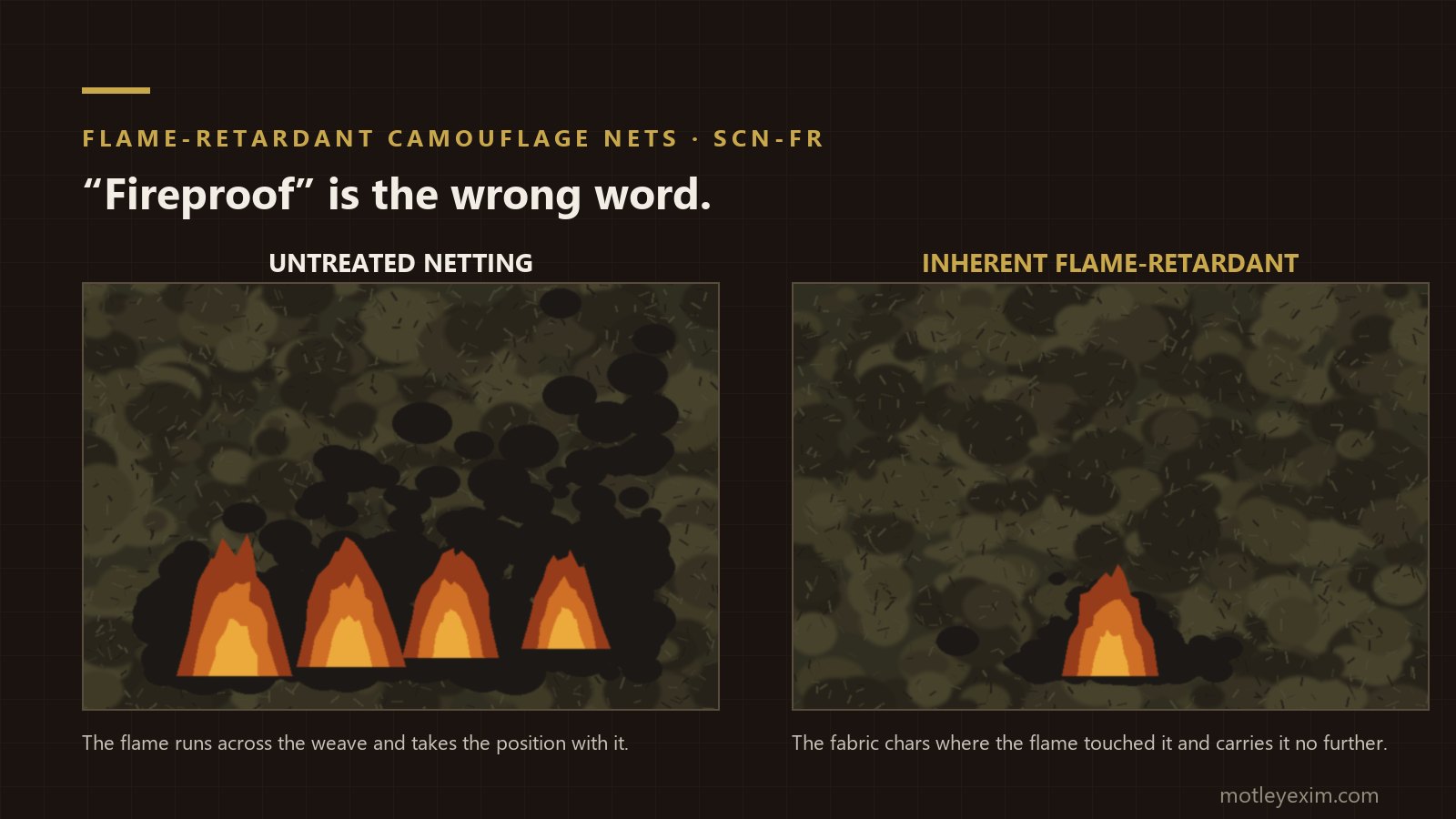
“Fireproof camouflage net” is a phrase people search for, and it describes something that does not exist. Textiles are not fireproof. What a properly built net is, is flame-retardant: it chars where the flame touches it and refuses to carry that flame across the weave. The difference sounds like wording until the first time a spark lands on cover stretched over a fuel point. This guide covers what flame-retardant really means for camouflage netting, why inherent and treated are not the same thing, and what to put in a specification.
TL;DR
- Nothing textile is fireproof. The right word is flame-retardant: the fabric chars locally and does not carry the flame.
- Inherent beats treated. A surface treatment wears off with handling, rain and washing, and nothing on the net tells you it has gone.
- A burning net does the opposite of its job — the smoke and heat mark the position it was hiding.
- Flame-retardant chemistry can change infrared behaviour. Verify the bands and the burn behaviour on the same finished net.
- Ask for the accredited laboratory report on the finished net, not on the yarn.
“Fireproof” is the wrong word
Three words get used as if they meant the same thing. Fireproof means the material is not affected by fire at all, which no camouflage textile is. Fire-resistant usually describes a material that resists ignition for a period. Flame-retardant describes what actually matters in the field: when a flame reaches the fabric, the fabric chars where it was touched and does not sustain or spread the flame once the source is removed.
A flame-retardant net still gets damaged. A hole is a hole. The difference is whether you lose a patch of netting or the whole position.
Why it matters more for cover than for clothing
A camouflage net is fabric and garnish with air on every side, spread over the things that start fires: hot exhausts and engine decks, generators, welding and grinding in a workshop area, cooking, refuelling, and the stores in a depot. Our guide to concealing fixed installations deals with fuel and ammunition areas, and concealment on the move with vehicles halting on hot engines — both are exactly where cover meets heat.
There is a concealment argument too, not only a safety one. Burning cover produces smoke, light and a large thermal source. A net that catches and spreads flame advertises the position it was rigged to hide, and it does it at the worst possible moment.
Inherent versus treated: the question that decides everything
Flame retardancy arrives in a net in one of two ways. A treatment is applied to a finished net — dipped or sprayed — and it works, at first. It also washes out, abrades off at the folds and handling points, and degrades under sunlight. Nothing about the net changes colour or texture when the protection has gone, so a crew cannot tell a protected net from an unprotected one by looking at it.
Inherent flame retardancy is built into the fibre itself, so it cannot wash out or wear away; it lasts as long as the fabric does. Our woven and knitted nets and the three-dimensional multispectral net are built on inherently flame-retardant fabric for this reason. Ask which of the two you are being offered, in writing, before anything else in the fire conversation.
Flame retardancy must not cost you the bands
This is where cheap flame-retardant netting quietly fails. The chemistry that makes a fabric resist flame also changes its surface, and surface is exactly what decides how a material behaves in the near-infrared and short-wave infrared bands. A net can pass a burn test and still glow against the background through night-vision devices, or lose the thermal match described in our note on thermal signature.
So the two properties have to be proven together, on the finished net: the visible match, the near-infrared and short-wave infrared behaviour, the thermal behaviour, radar where it applies, and the flame behaviour. A report on the yarn is not a report on the net.
Where the flame-retardant version is worth specifying
- Fuel and refuelling points, and anywhere jerry cans are handled.
- Ammunition and explosive stores, where the consequence of spread is not measured in netting.
- Workshops and repair areas — welding, cutting and grinding throw sparks well beyond the work.
- Generator and power areas, with hot casings and fuel lines under cover.
- Vehicle harbours, where nets go over engine decks and exhausts that are still hot.
- Kitchens and heated shelters, the most common real-world ignition source in a static camp.
Cover over these areas is one part of the answer. The other is the passive fire protection that goes on the asset itself — a separate product family covered in fire-suppression materials explained and the fire suppression buyer’s guide. A flame-retardant net does not suppress a fire; it refuses to become one.
What to specify
- Inherent or treated — stated plainly, in the specification and on the offer.
- Accredited laboratory report on the finished net, not on the yarn or a sample swatch.
- Bands unchanged — visible, near-infrared, short-wave infrared, thermal, and radar where it applies.
- Durability — the behaviour after repeated rigging, recovery, washing and wet packing.
- The whole assembly — garnish, threads, edge reinforcement and the support system, not only the base fabric.
- Repair — how a damaged section is patched without losing either property.
- Terrain and season — the flame-retardant version still has to match the ground it is used on.
CAMPRO® camouflage nets are manufactured in India on inherently flame-retardant fabric, with NABL-accredited lab test reports available on request; defence exports are subject to India’s SCOMET export-control framework. For the wider requirement, see how to specify a multispectral camouflage net and the complete guide to camouflage nets.
Frequently Asked Questions
Are camouflage nets fireproof?
No, and any supplier who says so is using the wrong word. Nothing made of textile is fireproof. What a good net is, is flame-retardant: when a flame reaches it the fabric chars locally and stops carrying the flame instead of letting it run across the weave. The net is still damaged where the fire touched it. The point is that the fire does not spread through it and take the position, the vehicle or the stores with it.
What does “inherent fire retardant” mean?
It means the flame-retardant behaviour is built into the fibre itself rather than sprayed or dipped onto a finished net. A surface treatment works when the net is new, then wears off with handling, rain, washing and sunlight, and there is no way to see that it has gone. Inherent flame retardancy does not wash out or abrade away, which matters for cover that is rigged, recovered and packed wet for years.
Does a flame-retardant net still work against thermal and night vision?
It has to, and that is the question worth asking a manufacturer. Flame-retardant chemistry can change how a fabric reflects in the near-infrared and short-wave infrared bands, so a net that passes a burn test but has lost its infrared match is no longer camouflage. The multispectral behaviour and the flame behaviour must be verified on the same finished material, not on samples of each.
What is SCN-FR?
SCN stands for synthetic camouflage net; FR is the flame-retardant construction of it. Our synthetic nets are available in flame-retardant, pre-garnished and nylon constructions, so SCN-FR simply refers to the flame-retardant version of the same net rather than a separate product family.
Can an ordinary camouflage net catch fire?
Yes. A net is fabric and garnish with a lot of air around it, which is close to ideal conditions for fire to spread. Hot exhausts, welding and grinding sparks, cooking, generators, refuelling and tracer are all normal parts of a position, and an untreated net above them turns a small incident into a large one. Burning cover is also a signal: the smoke and heat mark the very position the net was there to hide.
What should be specified for a flame-retardant camouflage net?
Ask whether the flame retardancy is inherent or applied, and ask for the accredited laboratory test report for the finished net rather than for the yarn. Specify that the visible, near-infrared, short-wave infrared, thermal and radar behaviour is unchanged by the flame-retardant construction, and check durability after repeated rigging and washing, the behaviour of the garnish and the support system as well as the net, and the terrain and season the pattern has to match.
Procurement or technical question?
CAMPRO® camouflage, CAM-IRR® paint, fire-suppression systems, and export-compliance support. Our team replies within one business day.
Contact Our Team →