A synthetic camouflage net (SCN) is a camouflage net made from synthetic yarns that conceals what it covers in the visual and near-infrared bands. It comes in two constructions: woven nets are more robust and hold their shape, for fixed installations and heavy or static use; knitted nets are lighter and stretch to drape over complex shapes, for mobile units and rapid deployment. This guide explains how the two are made, how they compare, how to choose between them, and when a synthetic net is not enough.
TL;DR
- An SCN works in the visual and near-infrared bands. For thermal imagers or radar, specify a multi-spectral net instead.
- Woven: yarns interlaced at right angles give a stable, even surface that is more robust for heavy or static use.
- Knitted: yarn formed into interlocking loops is lighter, stretches and drapes over irregular shapes.
- Reversible nets carry a different pattern on each face, so one net covers a change of terrain.
- Specify the construction, the faces, the terrain and the tests on the finished net, not a material name alone.
What a synthetic camouflage net is
A synthetic camouflage net is built from synthetic yarns, and its job is the classic one: break up the outline of a vehicle, gun, position or store, and match the colour and pattern of the ground around it. A defence-grade SCN is also engineered for the near-infrared band, so it does not show as a dark shape through a night-vision device. CAMPRO® SCN nets are specified for concealment across ultraviolet, visual and near-infrared observation.
The abbreviation is read two ways. In tenders and on marketplaces SCN usually means synthetic camouflage net; in the CAMPRO® range it also stands for single or standard camouflage net, the counterpart of the multi-spectral MSCN. Both describe the same class of net: visual and near-infrared concealment, without the thermal and radar management a multi-spectral net adds. Our guide to camouflage terms compared sets SCN against MSCN; where thermal imagers or radar are part of the threat, start from a multi-spectral camouflage net instead.
Synthetic nets are the everyday workhorse. They are widely used as morcha nets over bunkers, trenches and gun positions, over vehicles and installations, and anywhere a net is deployed, struck and deployed again many times.
How woven and knitted nets are made
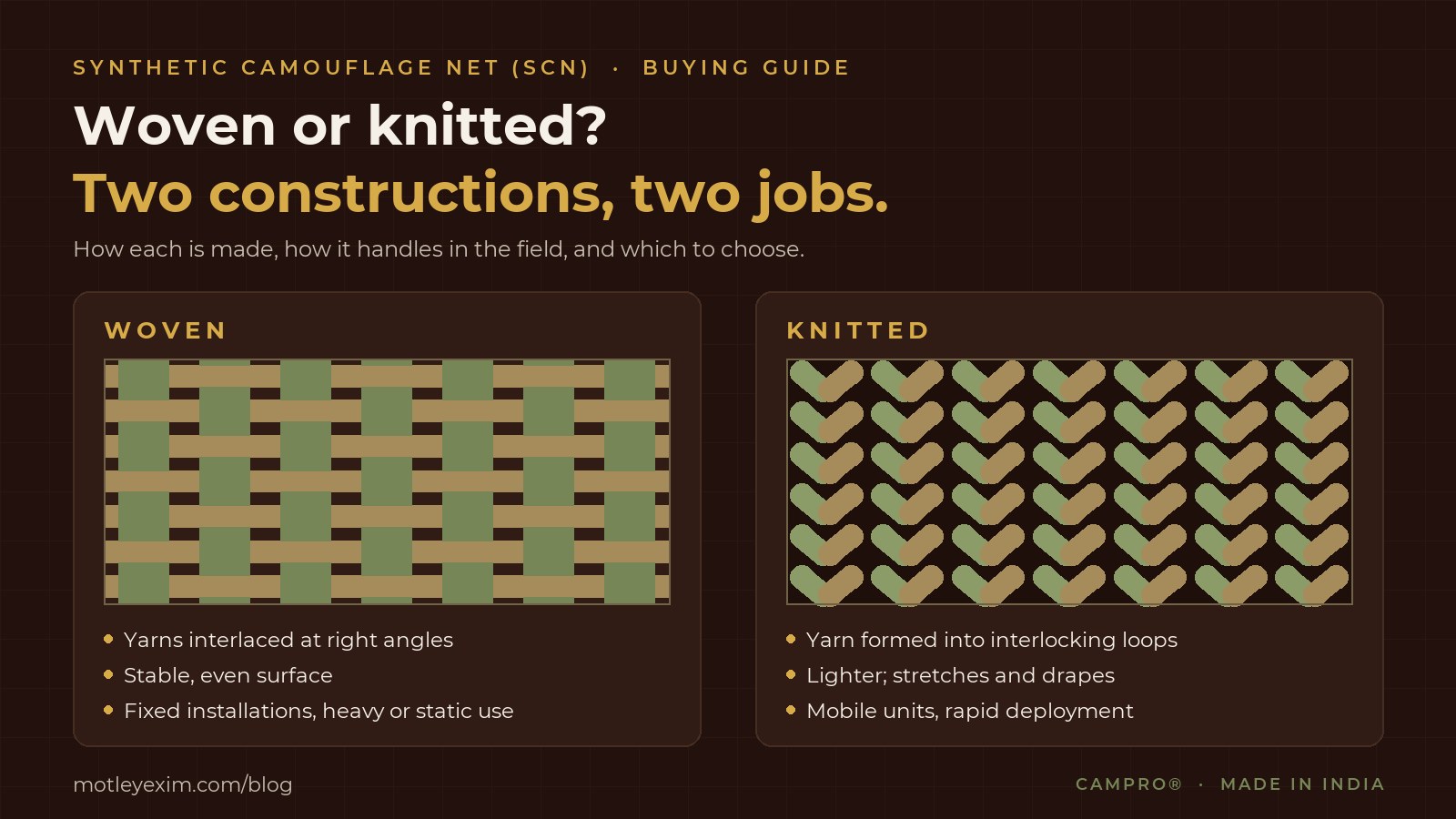
Woven. Two sets of yarns are interlaced at right angles, one running along the fabric and one across it. The result is a stable, even surface that holds its shape and keeps its pattern flat. CAMPRO® woven nets use a high-breaking-strength weave built to withstand repeated deployment and harsh field handling.
Knitted. The yarn is formed into rows of interlocking loops instead of being crossed. The loops give a knitted net natural stretch and drape: it conforms around irregular assets and terrain features, and it keeps the carry weight low, which is why knitted nets are the lighter of the two.
Both start from the same idea, a strong base net that carries the load and resists tearing, and both can carry the same colours, digital pattern and near-infrared treatment. The difference is in how the net behaves in the field.
Woven vs knitted at a glance
| Woven | Knitted | |
|---|---|---|
| How it is made | Yarns interlaced at right angles | Yarn formed into interlocking loops |
| Surface | Stable and even, holds its shape | Stretches and drapes |
| Weight in the CAMPRO® range | Under 250 GSM | Under 200 GSM, the lightest SCN weight class |
| Strength in use | More robust for heavy or static use | Easier to carry and to throw over awkward shapes |
| Best for | Fixed installations, long deployments | Mobile units, rapid deployment |
| Faces | Reversible or single-sided | Reversible or single-sided |
Neither is the better net in general. Woven is the safer choice where the net stays up for long periods or takes heavy handling; knitted is the better choice where it is carried, draped over awkward shapes and moved often.
Which construction for which job
- Fixed installations and long stays — depots, gun positions, morchas, parked vehicle lines: woven. It keeps its shape and its pattern through sun, weather and repeated mounting.
- Mobile units and quick set-ups — patrols, convoys at the halt, positions that move: knitted. Low carry weight and fast deployment matter more there than ultimate robustness.
- Irregular shapes — guns, antennas, vehicles with fittings: knitted drapes and conforms around them. Whichever net is used, the support poles and spreaders matter as much as the fabric; our guide to camouflage net sizing covers the cover and the frame.
- Heavy or static use over large areas — woven, the more robust of the two.
A unit that does both can hold both: woven nets for the fixed positions and knitted nets in the vehicles.
Reversible or single-sided
Both constructions come reversible or single-sided. A reversible net carries two different patterns on opposite faces, for example forest on one side and desert on the other, or winter white and summer terrain, so one net covers a change of terrain or season without carrying a second net. A single-sided net has one pattern and is simpler, lighter and more cost-effective where the terrain does not change.
Choose the colours from the ground the net will sit on, not from a catalogue name. Our guide to camouflage net colours explains how, and why the near-infrared match matters as much as the visible colour.
What to put in the requirement
- Construction: woven or knitted, and the job that decides it.
- Faces: reversible, naming both patterns, or single-sided.
- Terrain and season: colours with photographs or a reference to the ground, not a colour name alone.
- Bands: visual and near-infrared, with the near-infrared requirement tested on the finished net rather than on the yarn or the fabric. Our guide to NABL testing for defence suppliers explains what an accredited report does and does not prove.
- Flame retardancy: as an inherent property of the fibre (SCN-FR), not a surface coating and never "fireproof"; see flame-retardant camouflage nets.
- Size, quantity and accessories: net sizes, total area, and the deployment kit — telescopic poles, shape disruptors, ground stakes, connectors and a repair kit.
Construction is also one of the drivers of price; our note on what drives the price of a camouflage net covers the rest, and government buyers will find the purchase route in buying camouflage nets on GeM.
CAMPRO® synthetic camouflage nets are manufactured in New Delhi, India by Motley Exim Co. in all four forms — woven reversible, woven single-sided, knitted reversible and knitted single-sided — with a digital pattern, size and pattern customised on request, a minimum order of 500 sqm, and NABL lab test reports available on request. Defence exports are subject to India's SCOMET export-control framework. For the wider picture, see the complete guide to camouflage nets.
Frequently Asked Questions
What is a synthetic camouflage net?
A camouflage net made from synthetic yarns that conceals what it covers in the visual and near-infrared bands, used over vehicles, positions, installations and morchas. It comes woven or knitted, reversible or single-sided. It does not manage the thermal or radar signature; for those, a multi-spectral camouflage net (MSCN) is specified.
What is the difference between a woven and a knitted camouflage net?
A woven net interlaces two sets of yarns at right angles, which gives a stable, even surface that is more robust for heavy or static use. A knitted net is made of interlocking loops, which makes it lighter and lets it stretch and drape over complex shapes, so it suits mobile units and rapid deployment.
Which is lighter, a woven or a knitted camouflage net?
Knitted. In the CAMPRO® range the knitted SCN nets are under 200 GSM, the lightest weight class in the SCN range, and the woven SCN nets are under 250 GSM.
Does a synthetic camouflage net work against thermal imagers?
It is not designed to. An SCN is specified for the ultraviolet, visual and near-infrared bands. Where thermal imagers or radar are part of the threat, specify a multi-spectral camouflage net, which adds thermal and, where specified, radar management.
What does SCN-FR mean?
A synthetic camouflage net with fire retardancy. Ask for flame retardancy as an inherent property of the fibre rather than a surface coating that can wear away, and for the test report on the finished net. CAMPRO® SCN is available in fire-retardant (SCN-FR), pre-garnished and nylon constructions depending on the requirement.
Who manufactures synthetic camouflage nets in India?
Motley Exim Co. manufactures CAMPRO® synthetic camouflage nets in New Delhi, India, woven and knitted, reversible and single-sided, with a minimum order of 500 sqm, size and pattern customised on request, and NABL lab test reports available on request. Defence exports are subject to Indian export-control approval and need a valid End-User Certificate.
Choosing a net for a requirement?
CAMPRO® camouflage, CAM-IRR® paint, fire-suppression systems, and export-compliance support. Our team replies within 48 hours.
Contact Our Team →