
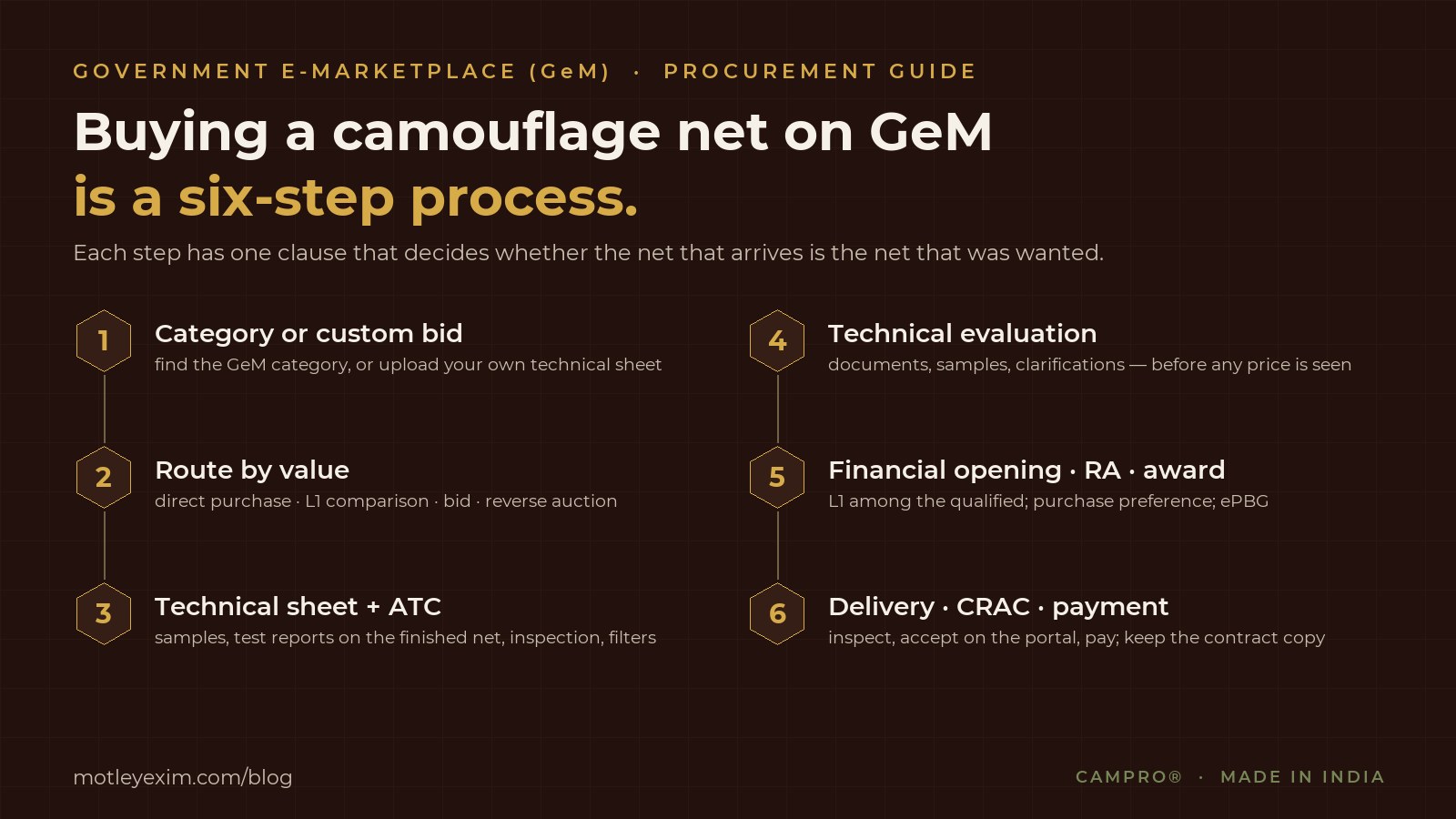
On GeM, a camouflage net is bought in six steps: find the category or raise a custom bid, pick the route the value allows, write the technical sheet and the ATC, evaluate the technical bids and samples, open the financial bids and run the reverse auction if one was enabled, then take delivery against a CRAC. This guide walks a government buyer through each step and the clauses that decide whether the net that arrives is the net that was wanted. It covers the GeM process only; what to put in the specification itself is in our specification guide.
TL;DR
- GeM is the default route. GFR 2017 Rule 149 sends central buyers to GeM for goods listed there, and camouflage nets are listed.
- Category bid or custom bid. A standard category rarely carries every parameter a defence-grade net needs.
- The ATC decides the outcome: samples, test reports on the finished net, inspection, and the experience filters.
- Technical evaluation is where net bids are won or lost. Price is seen only after it.
- Delivery closes on a CRAC. Inspect against the sheet before accepting.
What GeM is, and when a camouflage net has to be bought there
GeM — the Government e-Marketplace — is the online procurement portal of the Government of India, run under the Department of Commerce since 2016. Central ministries and departments, their attached and subordinate offices, public-sector enterprises and autonomous bodies buy through it, and many state governments and their undertakings have joined by agreement. Rule 149 of the General Financial Rules 2017 makes it the rule rather than the option: goods and services available on GeM are to be procured through GeM.
Camouflage nets are a listed category. For a central buyer — a formation, an ordnance depot, a central armed police force unit, a defence public-sector undertaking — GeM is therefore the first place a net requirement goes. What stays outside GeM are the large, specification-heavy capital procurements run under the Defence Acquisition Procedure and departmental tenders that pre-date the rule. Those use the same technical thinking but a different process; this guide is about the GeM one.
Step 1 — Find the category, or raise a custom bid
On the buyer side, a search for camouflage net returns product categories, each with a fixed set of parameters — construction, size, colour or pattern, material and so on — from which the buyer picks values. A category bid is quick and keeps every seller in the category eligible.
The limitation is that a standard category rarely carries the parameters that make a net defence-grade: near-infrared behaviour for night vision, thermal behaviour, radar transparency where a radar sits under the net, inherent flame retardancy, and the test methods for each. Where those matter, the buyer either adds them as buyer-specified parameters or raises a custom bid — a bid against the buyer's own technical sheet and bill of quantities rather than a catalogue entry. Whichever route is taken, the technical sheet becomes the contract. Our guide to camouflage netting types explains what the construction and band choices mean, and our specification checklist turns them into a requirement.
Step 2 — Choose the route the value allows
GeM offers four ways to buy: direct purchase from a listed seller, L1 comparison among listed offers, a bid, and a bid that ends in a reverse auction. Which of them a buyer may use depends on the estimated value: the slabs are set by GFR Rule 149 and revised from time to time, and the buyer dashboard shows the current ones.
For a net that has to meet near-infrared, thermal or flame-retardancy requirements, a bid is the practical route even when the value would allow a direct purchase, because direct purchase buys a catalogue item as listed and has no sample or test stage. Direct purchase and L1 comparison suit small quantities of a standard visual net. Whether the bid ends in a reverse auction is chosen when the bid is created: with it enabled, the technically qualified bidders bid their prices down in a timed window after technical evaluation.
Step 3 — Write the bid: the technical sheet and the ATC
The technical sheet states what the net must do, band by band, and how that will be checked — on the finished net, not on the yarn or the fabric. Colour is specified against the ground the net will sit on, as our guide to camouflage net colours sets out, and flame retardancy is asked for as an inherent property of the fibre, not as "fireproof", which no fabric net honestly is (see flame-retardant camouflage nets).
The ATC — Additional Terms and Conditions — is where buyers of nets add what the category does not carry. The clauses that matter most:
- Samples — submitted before technical evaluation and examined by a committee against the sheet.
- Test reports from an NABL-accredited laboratory (or equivalent) on the finished net, with the test method named for each parameter. Our guide to NABL certification for defence suppliers explains what accreditation does and does not prove.
- Inspection — by the consignee, a nominated agency or a quality-assurance directorate — and whether it happens before dispatch or on receipt.
- Delivery period and consignee locations, warranty, packing and marking.
GeM also offers standard eligibility filters the buyer switches on and sets. The experience criterion asks that the bidder — or its OEM, directly or through resellers — has manufactured and supplied the same or similar category of product to a central or state government organisation or a public-sector undertaking for a stated number of financial years. The past-performance criterion asks that it has supplied a stated percentage of the bid quantity to the same class of buyer in at least one of the last three financial years. In both, the proof is copies of the relevant contracts. The number of years and the percentage are the buyer's choice per bid: set too high they empty the field, set too low they let unproven sellers through, so they should follow what the requirement justifies. Turnover filters work the same way.
Two more settings shape who can win. The Public Procurement (Preference to Make in India) Order gives purchase preference by local-content class, and GeM applies it from the seller's declared class; the Public Procurement Policy for Micro and Small Enterprises gives MSEs their preference where the buyer enables it. The buyer also decides whether an earnest-money deposit applies and the size of the performance guarantee the winner furnishes, the bid validity, the delivery days, and whether evaluation is on total value or item by item.
Step 4 — Technical evaluation and samples
A GeM bid is evaluated in two stages, and the technical stage comes first: nobody sees a price until the committee has decided who qualifies. The committee checks each bidder's documents against the sheet and the ATC, examines the samples, and seeks clarifications through the portal where a document is ambiguous.
This is where camouflage-net bids are decided. The failures are familiar: test reports on the yarn or the fabric rather than the finished net; a report that names no test method; near-infrared data missing altogether; a colour described by a name with no reference to the terrain; "fireproof" offered against a flame-retardancy requirement. A clear sheet makes these decisions defensible — the committee disqualifies on the written requirement, not on taste — and it is also what protects the buyer if a decision is challenged.
Step 5 — Financial opening, reverse auction and award
Only the technically qualified bids are opened. The lowest price under the evaluation method chosen is L1; if a reverse auction was enabled, it runs among the qualified bidders first and the price at its close counts. Purchase preferences are then applied as the orders provide, the contract is generated on the portal, and the winner furnishes its performance guarantee within the time the bid allowed. A price that looks implausibly low against the sheet is worth a written justification request before award rather than a dispute after delivery.
Step 6 — Delivery, inspection, CRAC and payment
The seller dispatches within the delivery period and raises its invoice on the portal. The consignee — or the inspection agency the ATC named, in a joint inspection where it said so — checks the consignment against the sheet and the accepted sample and then generates the CRAC, the Consignee's Receipt and Acceptance Certificate, on GeM. The CRAC is the acceptance: it starts the payment clock the portal enforces, and it closes the contract. A consignment that does not match is rejected on the portal with reasons; delay beyond the allowed period attracts liquidated damages under the bid's terms.
Both sides should keep the contract copy. For the buyer it is the audit record. For the seller it is the proof the next bid's experience criterion will ask for — a delivery counts by who received it, so a contract that names the product and the government or PSU consignee is worth more than any certificate.
Six mistakes that cost buyers the net they wanted
- Copying a category's parameter list into a requirement that needs near-infrared or thermal performance.
- Writing "fireproof" instead of inherent flame retardancy.
- Accepting test reports on the yarn or the fabric instead of the finished net.
- Naming a colour without photographs or a reference to the terrain.
- Leaving out the sample clause, so the first physical net anyone sees is the delivery.
- A delivery period that no manufacturer can meet with a tested, inspected net — which leaves only the untested ones.
A note for manufacturers reading this
A manufacturer sells on GeM as a registered seller, with its catalogue in the right categories and, as an OEM, a vendor assessment behind it. Because the experience and past-performance filters count deliveries by who received them, the paperwork that matters is a contract copy for every supply to a government or PSU buyer — including supplies made through a reseller, which the standard clause lets the OEM count. CAMPRO® camouflage nets are manufactured in India by Motley Exim Co., which bids on GeM as a manufacturer; NABL-accredited lab test reports on the finished net are available on request, and defence exports are subject to India's SCOMET export-control framework. For the wider picture, see our guide to choosing a camouflage net supplier in India, what drives the price of a camouflage net, and the complete guide to camouflage nets.
Frequently Asked Questions
Is it mandatory to buy camouflage nets through GeM?
For central government buyers, yes in practice: Rule 149 of the General Financial Rules 2017 requires goods and services available on GeM to be procured through GeM, and camouflage nets are a listed category. State buyers follow their own rules, many of which adopt GeM by agreement. Large, specification-heavy capital procurements under the Defence Acquisition Procedure follow their own process.
Should a camouflage net be bought by direct purchase or by bid?
By bid wherever the net has to meet near-infrared, thermal or flame-retardancy requirements, because direct purchase buys a catalogue item as listed and has no sample or test stage. Direct purchase and L1 comparison suit small quantities of a standard visual net. Which routes the value allows is set by GFR Rule 149 and shown on the buyer dashboard.
What should the ATC of a camouflage-net bid contain?
Samples submitted before technical evaluation and examined by a committee; test reports from an NABL-accredited or equivalent laboratory on the finished net, with the method named for each parameter; who inspects and when; the delivery period and consignee locations; warranty, packing and marking; and the experience and past-performance filters with the proof accepted, normally copies of contracts.
What is the past-performance clause on GeM?
A standard eligibility filter the buyer can switch on. It asks that the bidder, or its OEM directly or through resellers, has supplied the same or similar category of product for a stated percentage of the bid quantity in at least one of the last three financial years to a central or state government organisation or a public-sector undertaking, with copies of the relevant contracts as proof. The percentage is the buyer's choice for each bid.
Can a GeM buyer ask for samples and laboratory test reports?
Yes, through the ATC. Ask for the sample before technical evaluation, for test reports on the finished net rather than the yarn or fabric, for the test method to be named for each parameter, and for the laboratory to be NABL-accredited or equivalent. A requirement written this way is also what makes a disqualification defensible.
What is a CRAC and why does it matter?
The Consignee's Receipt and Acceptance Certificate, generated on GeM by the consignee after inspecting the delivery. It is the acceptance that starts the payment clock and closes the contract, and it is the record of the delivery for both sides, so it should be issued only after the consignment has been checked against the technical sheet and the accepted sample.
Procurement or technical question?
CAMPRO® camouflage, CAM-IRR® paint, fire-suppression systems, and export-compliance support. Our team replies within 48 hours.
Contact Our Team →