
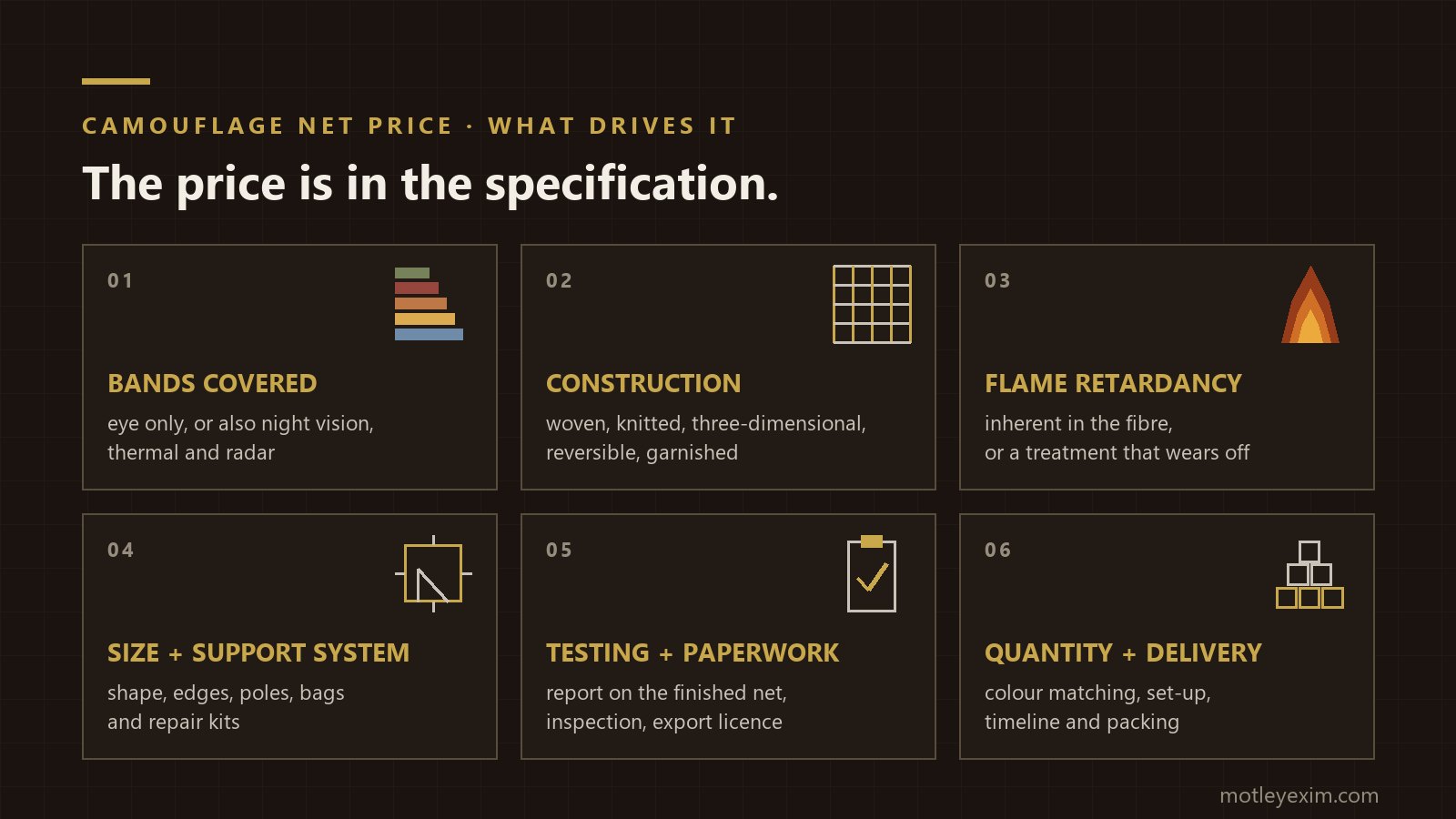
Two quotes for “a camouflage net” can be far apart, and both can be honest. A camouflage net is not priced like a commodity; it is priced from its specification. That is why this guide does not quote figures. It explains what actually moves the price of a camouflage net up or down, which of those costs buy real protection in the field, and how to put two quotations side by side fairly.
TL;DR
- The specification sets the price. Which bands the net has to manage matters more than its size.
- Construction and inherent flame retardancy add cost for reasons that show up in the field.
- Size, shape, the support system and packing are often quoted separately — check what is in the price.
- A test report on the finished net, inspection and export paperwork are real costs, not padding.
- Compare quotes against one written specification and over the service life, not by the headline number.
The specification sets the price
A request for “a camouflage net” can bring back quotations for very different things: a printed shade mesh, a net that matches the ground to the eye only, or an engineered net that manages several sensor bands at once. Our comparison of military and commercial camouflage nets covers that first split. This guide is about the second question — why two genuine military-grade nets can still be priced far apart.
The answer is almost always in the specification. Every line below either adds material, adds work, adds testing, or adds risk for the manufacturer, and the price follows.
Bands covered: the biggest single driver
The first question to ask of any quote is which bands the net has been built and tested for. A net that only has to match colours to the eye is the simplest to make. Each band added on top — near-infrared for night vision, short-wave infrared, thermal, and radar — needs its own pigment, fibre or material work and its own test, and all of them have to hold together on one finished net. Our guide to the UV, NIR and TIR spectrum explains what each band sees.
Radar is a decision of its own. Some requirements need a net that lets radar pass, such as our radar-transparent camouflage net; others need one that weakens radar returns. The two are built differently and priced differently, so the quote has to say which one it is.
Construction: woven, knitted, three-dimensional, garnished
How the net is made changes both what it costs and what it does. A woven reversible net carries a different pattern on each face, so one net can serve two terrains or two seasons. A knitted net drapes and packs differently. A three-dimensional multispectral net uses more material and more work to give the surface depth, which breaks up outline and shadow in a way a flat net cannot. Pre-garnished nets add the garnish at the factory instead of in the field.
None of these is simply “the expensive option”. A reversible net can replace two nets; a three-dimensional net can do the job of a flat net plus field garnish. Price the construction against the work it saves.
Flame retardancy: inherent costs more, and should
A flame-retardant treatment applied to a finished net is cheaper at the start. It also washes out, wears off at the folds and fades in sunlight, with nothing on the net to show that it has gone. Inherent flame retardancy is built into the fibre and lasts as long as the fabric. Our guide to flame-retardant camouflage nets explains why that difference matters over cover stretched above fuel, engines and stores. When two quotes differ, check this line first.
Size, shape and the support system
Area drives material, so size matters — but shape matters too. Nets cut to cover a particular vehicle, a gun position or an irregular site take more pattern and finishing work than standard sheets. Edge reinforcement, joining points and how nets connect to each other all add to the price and to how quickly a crew can rig them.
Then there is everything around the net: poles, spreaders, pegs, carry bags and repair kits. Some suppliers include them; others quote them as separate lines, or leave them out. A net without the right support system cannot be rigged properly, so make sure every quote covers the same items.
Testing, inspection and paperwork
A credible quotation includes evidence. Laboratory testing of the finished net, rather than of the yarn, costs money and time. So do samples for a user trial, inspection by the buyer before dispatch, and the marking and packing a tender asks for. A quote that is lower because it leaves these out is not cheaper; it simply moves the risk to the buyer.
For orders from outside India, export documentation is part of the job. Defence exports from India fall under the SCOMET export-control framework, and the licence and end-user paperwork take time that belongs in the delivery plan. Our export compliance guide explains what is involved.
Quantity, colour matching and delivery
Much of the work in a camouflage net order happens before the first net is made: matching colours to the terrain samples, setting up production for the pattern and construction, and testing each lot. A larger order spreads that work across more nets, so the price per net usually falls with quantity. A custom terrain colour costs more than a standard one for the same reason.
Delivery terms matter as well. A compressed timeline, split deliveries to several locations or special packing all change the price, and they belong in the specification rather than in a phone call after the order.
When a cheaper net costs more
The headline price is the least useful number in a camouflage net quotation. A net whose flame-retardant treatment washes out, whose infrared match fades after a few seasons in the sun, or which takes so long to rig that crews stop using it on short halts, has to be replaced or is simply left in its bag. The question worth asking is what each net costs per year of service in the terrain it is meant for — and that depends on durability evidence after ageing, which our specification guide treats as a requirement, not a bonus.
How to compare two quotations
- Same bands, same test. Visible, near-infrared, short-wave infrared, thermal and radar, each stated, each tested on the finished net.
- Inherent or treated flame retardancy, in writing.
- Same construction — woven or knitted, reversible or not, flat or three-dimensional, garnished or not.
- Same size, shape and edge finishing, and the same number of nets.
- Same scope — support system, bags, repair kits and packing included or listed.
- Evidence — an accredited laboratory report on the finished net, and durability after ageing.
- Terms — inspection, delivery timeline, validity of the offer and, for exports, the licence route.
CAMPRO® camouflage nets are manufactured in India on inherently flame-retardant fabric, with NABL-accredited lab test reports available on request; defence exports are subject to India’s SCOMET export-control framework. For a quotation, send the bands, terrain and season, size and quantity, and delivery location — the checklist in how to specify a multispectral camouflage net covers the rest. For the wider picture, see the complete guide to camouflage nets.
Frequently Asked Questions
How much does a camouflage net cost?
There is no honest single figure, which is why this guide does not quote one. The price depends on which bands the net has to manage — visible only, or also near-infrared, short-wave infrared, thermal and radar — on its construction, on whether the flame retardancy is inherent, on its size and shape, on the support system and packing included, on the testing and inspection required, and on the quantity. A quotation against a written specification is the only price that means anything.
Why is a multispectral camouflage net more expensive than an ordinary one?
Because it does more work. An ordinary net only has to match the colours of the ground to the eye. A multispectral net also has to behave like the background under night vision, in the short-wave infrared, on a thermal imager and, where specified, to radar. Each band needs its own materials and its own test, and all of them have to hold together on the same finished net.
Why do two quotes for the same camouflage net differ so much?
Usually because they are not for the same net. One may cover fewer bands, use a treated rather than an inherently flame-retardant fabric, leave out the support system and bags, or offer no test report on the finished net. Put the quotes side by side line by line against one written specification before comparing the totals.
Is the support system included in the price of a camouflage net?
It depends on the supplier and on the requirement, so ask. Poles, spreaders, pegs, carry bags and repair kits are sometimes part of the net price and sometimes quoted as separate lines. A net without the right support system cannot be rigged properly, so make sure both quotes include the same items.
What should I send to get a camouflage net quotation?
The bands the net must manage, the terrain and season it has to match, the construction you prefer, the size, shape and quantity, whether inherent flame retardancy is required, the support system and packing, the testing and inspection you expect, and the delivery location and timeline. For orders from outside India, also the end-user details needed for the export licence.
Does a larger order lower the price per net?
Usually, because the set-up work — matching colours to the terrain samples, preparing production and testing each lot — is shared across more nets. Quantity moves the price less than the specification does, though. A large order of the wrong net is still the wrong net.
Procurement or technical question?
CAMPRO® camouflage, CAM-IRR® paint, fire-suppression systems, and export-compliance support. Our team replies within one business day.
Contact Our Team →