
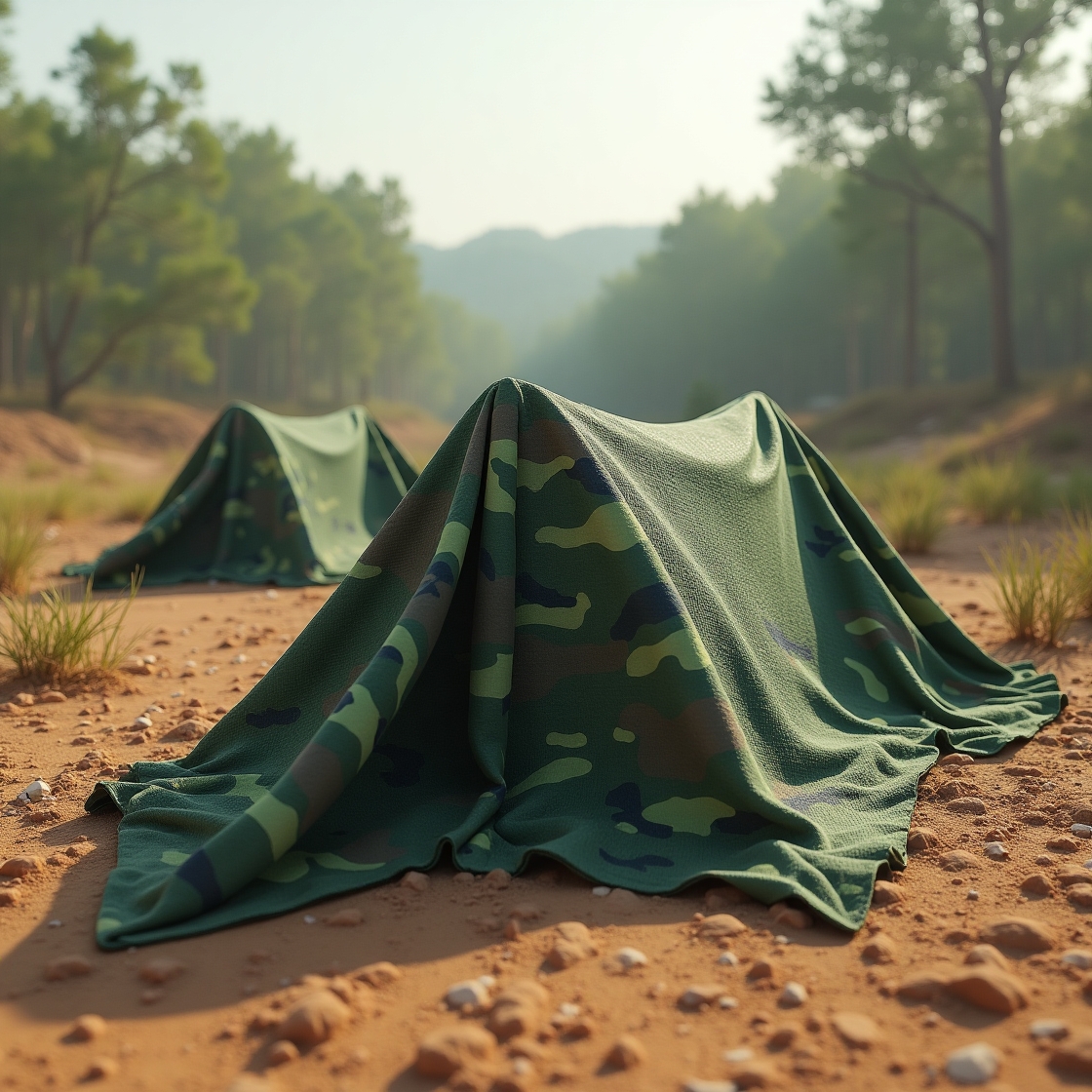
A multi-spectral camouflage net is a camouflage net engineered to manage how an asset appears across several sensor bands at once — the eye and daylight cameras, near-infrared night vision, thermal imagers and, where specified, radar — rather than matching colour alone. CAMPRO® multi-spectral camouflage nets are manufactured in New Delhi by Motley Exim Co., NABL-tested band by band, with lab reports available on request.
TL;DR
- Coordinated concealment: a multi-spectral net manages how an asset appears to the eye, night-vision devices, thermal imagers and, where specified, radar — not colour alone.
- Band by band: ultraviolet, visual, near-infrared, short-wave infrared and thermal, plus radar on radar-managed nets; each band needs its own materials and its own test.
- Made in India: CAMPRO® multi-spectral camouflage nets are manufactured in New Delhi by Motley Exim Co., NABL-tested, with lab reports available on request.
- Wide applications: vehicles at the halt, field camps and bunkers, weapon positions, radar units and aircraft on the ground.
- Built for the field: inherently flame-retardant fabric, terrain-matched patterns for jungle, desert, snow and urban ground, and reversible two-terrain versions.
What are multi-spectral camouflage nets?
Multi-spectral camouflage nets are concealment systems designed to mask military assets from detection across multiple surveillance bands — visible, near-infrared, thermal and, in radar-managed types, radar. They matter because modern reconnaissance rarely looks in one band: a drone or an observation post may carry a daylight camera, an image intensifier and a thermal imager together, and a net that is right for only one of them hands the others a clean target.
The word multi-spectral is a claim about engineering, not colour. A net dyed in the right greens is a visual net; it becomes multi-spectral only when its reflectance in the near-infrared, its behaviour on a thermal imager and, where specified, its radar return have been designed and tested on the finished net. Our complete guide to multi-spectral camouflage covers the physics; this page is about the net itself and how it is made and bought in India.
How do multi-spectral camouflage nets work?
Multi-spectral nets are engineered from fibres and coatings that interact with different parts of the electromagnetic spectrum, so that what the net covers reads like the background through each sensor:
- Visual: a disruptive pattern breaks up the shape underneath and blends it into the terrain colours.
- Near-infrared (night vision): the colours reflect near-infrared light the way living vegetation does, so the net does not go dark through an image intensifier.
- Short-wave infrared: the same match carried into the band that some surveillance cameras use, beyond what night-vision devices see.
- Thermal: the materials and construction reduce the warm outline a thermal imager sees. No net removes heat; it reduces how much a covered object stands out, and what is done underneath — engines off, hot surfaces covered, a gap between net and equipment — decides half the result.
- Radar (radar-managed nets): a scattering layer breaks up the radar return of what is underneath and lowers its radar cross-section; a radar-transparent net does the opposite and lets your own radar or antenna work through it.
- Ultraviolet: matched in the UV band as well, which matters most in snow, where ambient UV reflectance is high.
- Weather and fire: built on inherently flame-retardant fabric and made to hold its match through heat, cold, humidity and sun.
Key applications of multi-spectral camouflage nets
- Field camps and bunkers: field bases, tents and sensitive installations.
- Armoured vehicles: tanks, armoured personnel carriers and mobile artillery at the halt.
- Aircraft and helipads: aircraft on the ground and the pads they use, against airborne and satellite sensors.
- Missile systems and radar units: critical equipment that is easy to recognise by its shape.
- Coastal and naval bases: port facilities and moored craft against thermal and visual tracking.
How a net is rigged matters as much as what it is made of: standoff from the equipment, support poles and spreaders, and edges that follow the ground. Our guide to camouflage netting types and uses covers construction and deployment in more detail.
Multi-spectral vs. conventional camouflage nets
A conventional camouflage net matches colour and pattern for the eye and for daylight cameras. Through an image intensifier its dyed fabric can read as a dark patch, and on a thermal imager it does little to soften the warm shape underneath. To the eye the two kinds of net can look identical; the difference shows only through the sensor.
A multi-spectral net is engineered band by band — colour and near-infrared reflectance matched to the terrain, construction that reduces thermal contrast and, where specified, a radar-managed layer — and it is tested in each band on the finished net. That is also why it costs more: each band needs its own materials and its own test, and all of them have to hold together on the same net. Our comparison of IR camo netting and multi-spectral camouflage looks at when each is the right choice.
Why multi-spectral camouflage nets matter for India’s defence
- Concealment across the bands a threat actually uses: modern multi-sensor surveillance, including small drones with thermal payloads.
- Adaptable to terrain: patterns and colourways for desert, jungle, urban and snow-covered ground, and reversible nets that carry two.
- Lightweight and portable: quick to deploy and recover for rapid set-up or relocation.
- Mobile and static use alike: convoy halts, staging areas and long-term positions.
- Domestic manufacturing: nets made in India keep the specification, the testing and the supply chain inside the country and reduce dependence on imports.
CAMPRO® multi-spectral camouflage nets made in India
Motley Exim Co. has manufactured camouflage nets in New Delhi since 1999, under the CAMPRO® brand since 2002. The range covers the common requirements a specification raises:
- CAMPRO® 6 dB MSCN and CAMPRO® 12 dB MSCN — radar-managed multi-spectral nets at two attenuation levels;
- CAMPRO® 3D MSCN — a three-dimensional net that adds real shadow to the pattern;
- CAMPRO® 2D reversible MSCN — a different terrain on each face;
- radar-transparent camouflage net — for positions where your own radar must keep working.
All are made on inherently flame-retardant fabric and NABL-tested, with lab reports available on request; defence exports are subject to India’s SCOMET export-control framework and need an End-User Certificate. The checklist in how to specify a multi-spectral camouflage net turns a requirement into a specification, and what drives the cost of a camouflage net explains why the bands you ask for decide what you pay.
Final thoughts
As surveillance technology evolves, concealment has to keep pace. A multi-spectral camouflage net is one of the few pieces of equipment that answers several sensors with one item, and nets made in India are now specified and tested band by band in the same way as any other. Built for performance, portability and reliability, they are a core part of how concealment is achieved in the field.
Looking for multi-spectral netting for a defence requirement? Contact our team with the bands, terrain and season, size and quantity, and delivery location.
Related reads:
Frequently Asked Questions
What makes a camouflage net “multi-spectral”?
It is engineered and tested for several wavelength bands rather than colour alone — visible, near-infrared, short-wave infrared, thermal and, where specified, radar and ultraviolet — so what it covers reads like the background through each sensor. A conventional net only matches colour and pattern for the eye.
Can multi-spectral nets be reused?
Yes. They are designed for extended field use and repeated deployment cycles under harsh environmental conditions. Store them dry and inspect the edges and attachment points after each use.
Are they custom-made for different terrains?
Yes. Patterns and colour schemes are made for terrain types such as desert, forest, snow and urban ground, and reversible nets carry a different scheme on each face so one net serves two terrains or two seasons.
Are Indian camouflage nets export-ready?
Yes. CAMPRO® nets are exported from India under the SCOMET export-control framework. Defence exports need Indian export-control approval and a valid End-User Certificate, and supply is not available to sanctioned or embargoed destinations.
What is the typical lifespan of these nets?
With proper handling, high-grade nets can last 3–5 years or longer, depending on usage and storage conditions. Ask the supplier for evidence that the flame retardancy and the infrared match hold after ageing, not only at delivery.
Who makes multi-spectral camouflage nets in India?
Motley Exim Co. manufactures CAMPRO® multi-spectral camouflage nets in New Delhi — 2D, 3D and reversible nets and radar-managed versions — NABL-tested, with lab reports available on request. Other Indian makers exist; whoever you buy from, ask for test results on the finished net, band by band.
Which bands does a multi-spectral camouflage net cover?
Typically ultraviolet, visual, near-infrared, short-wave infrared and thermal infrared; radar-managed versions add the radar band. A specification should name the bands it needs and ask for a test result in each, because a net can be good in one band and poor in another.
How are multi-spectral camouflage nets tested?
In an accredited laboratory, band by band, on the finished net rather than the raw fabric: colour and near-infrared reflectance against the terrain reference, thermal behaviour, and attenuation for radar-managed nets. CAMPRO® nets are tested in NABL-accredited laboratories and reports are available on request.
Procurement or technical question?
CAMPRO® camouflage, CAM-IRR® paint, fire-suppression systems, and export-compliance support. Our team replies within 48 hours.
Contact Our Team →Multi-spectral threat — the full sensor stack
The sensor stack this is engineered against
Modern detection is multi-spectral: electro-optical targeting such as Sniper ATP and LITENING in the visible band; image-intensified night vision and 1064 nm laser designation in the near-infrared; infrared search-and-track such as OLS-35 and PIRATE and imaging-IR seekers such as AIM-9X and Javelin across the thermal bands; and AESA fire-control radars such as the AN/APG-81 in the radar band. CAMPRO multi-spectral systems are engineered to suppress a signature across this full sensor stack. This guide is educational and states no product performance figures.