
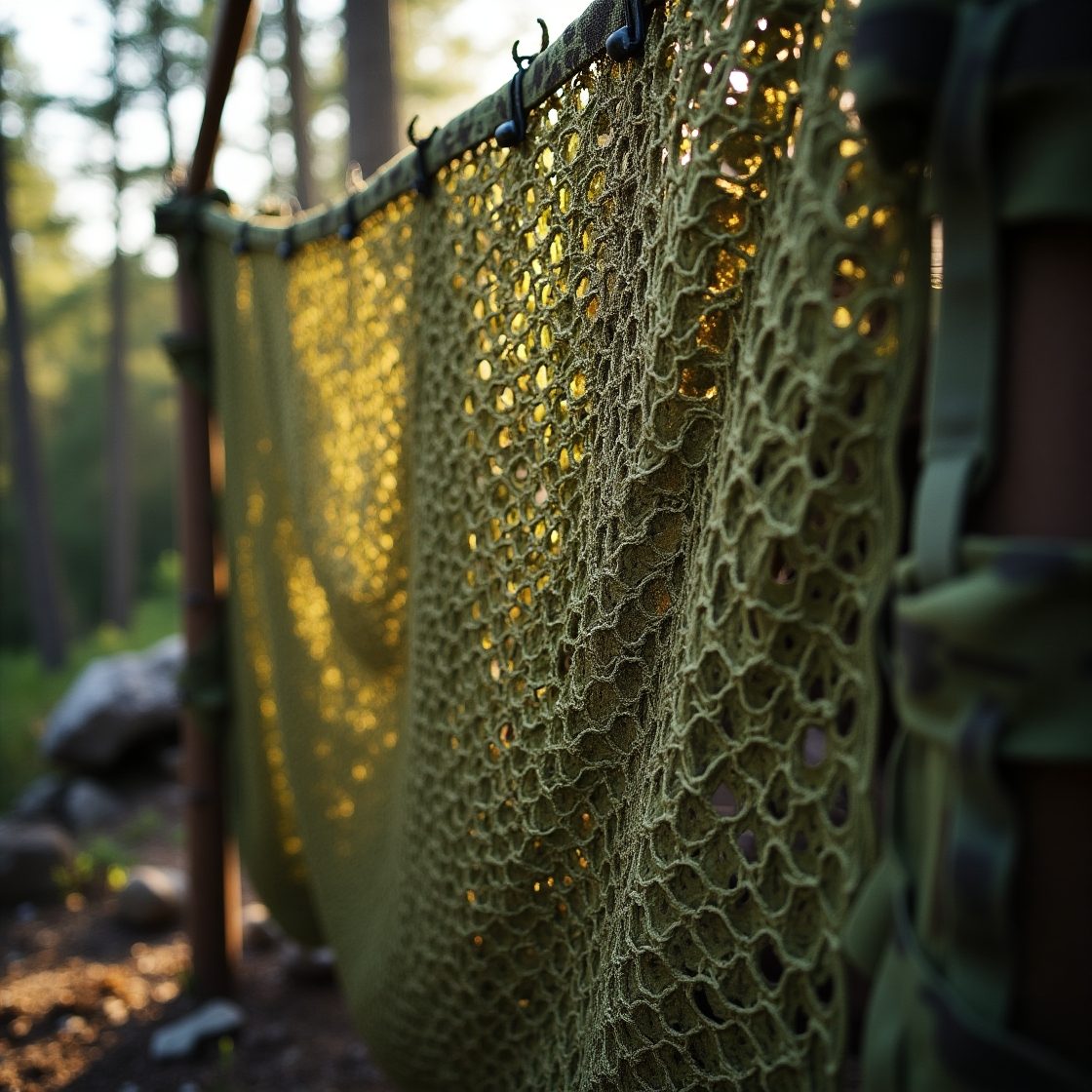
IR camo netting — infrared camouflage netting — is a camouflage net built to match its background in the infrared bands as well as to the eye. It makes vehicles, equipment and positions harder to pick out for night-vision devices, which see near-infrared light, and for thermal imagers, which see heat. This guide explains how it works, where it is used, how to deploy it, and what to ask for when you buy it.
TL;DR
- IR netting matches the background in infrared, not just to the eye.
- Two different bands: near-infrared (night vision, reflected light) and thermal (heat). Ask for both.
- No net blocks heat. It reduces contrast — and works best with heat discipline underneath.
- How it is deployed matters as much as the net: off hot surfaces, outline broken, edges blended.
- Ask for inherent flame retardancy, not “fireproof”, and test reports on the finished net.
What IR camo netting is
An ordinary camouflage net is coloured and patterned for the eye. That is not enough once an observer uses a night-vision device or a thermal imager, because both see the world differently from the eye. IR camo netting — also called IR netting, infrared camouflage netting or an infrared camouflage net — is built for those sensors as well. It is a cover that keeps whatever is underneath from standing out in the infrared, by night as well as by day.
It does not make anything disappear. What it does is reduce the contrast between the covered object and the ground around it, so the object is harder to find, harder to recognise and slower to target.
Two infrared bands, two different problems
“Infrared” covers two quite different things, and a net has to deal with each in its own way. Our explainer on the spectrum from ultraviolet to thermal infrared shows where they sit.
- Near-infrared (night vision). This is reflected light, just beyond red. Living leaves reflect a great deal of it; ordinary dyed fabric reflects far less, so a net that looks right by day can look dark and out of place through an image intensifier. An infrared net’s colours are made to reflect near-infrared the way its background does — the same idea as NIR-reflective paint on vehicles. Our guide to camouflage net colours covers this colour by colour.
- Thermal infrared (heat). This is energy that every surface gives off according to its temperature and material. A thermal imager sees warm shapes against a cooler background. Here the net works through its materials and construction: it shades what is underneath, breaks up the warm outline and keeps its own surface behaving more like the ground. Our guide to thermal camouflage netting goes further into heat.
A net can be good in one of these bands and poor in the other. That is why a specification should name both, and why both should be tested on the finished net.
How an infrared net works in the field
- Breaking the shape. Straight edges, regular outlines and sharp shadows give a position away in every band. A textured or three-dimensional surface, like our three-dimensional multispectral net, breaks them up.
- Matching the background. Colours and pattern for the eye, and near-infrared behaviour for night vision, are matched to the terrain and season the net is used in.
- Managing heat underneath. A net that lies on a hot engine deck soon becomes a warm patch itself. Space between the net and hot equipment, and air movement under the net, stop heat building into hot spots.
- Working with other layers. Infrared netting does the most when the equipment under it is also treated — infrared-reflective and anti-thermal coatings on the vehicle, and heat discipline by the crew.
Where IR netting is used
- Vehicles at a halt — tanks, trucks and guns covered during rest or in hides, where engines and exhausts are the first thing a thermal imager finds. See concealment on the move.
- Command posts, shelters and stores — tents, generators and supply points that stay in one place and are watched repeatedly. See concealing fixed installations and depots.
- Radar and communication sites — where the net also has to let signals through, which calls for a radar-transparent net.
- Observation posts and hides — small, low cover for people, where body heat is the signature to manage.
How to deploy IR camouflage netting
- Match the terrain and season. A woodland net on dry ground or snow stands out in every band.
- Keep it off hot surfaces. Use poles and spreaders to hold the net clear of engines, exhausts and generators; set out in our support system guide.
- Cool what you can first. Switch off and let engines and exhausts cool before covering, where the situation allows.
- Break the outline. Do not drape a neat box over the object; vary the edges and avoid repeated, regular shapes.
- Anchor it. A net moving in the wind draws the eye and the camera. Pegs, ties or weights keep it still.
- Blend the edges. Tie the net into trees, scrub, folds in the ground and other natural cover.
- Look after it. Store it dry, repair tears, and check it before use; a net that has faded or been damaged no longer matches its background.
Flame retardancy: what to ask for instead of “fireproof”
Buyers often search for “fireproof infrared camouflage net”. No fabric net can honestly claim that. What matters is inherent flame retardancy: built into the fibre so that it does not wash out, wear off at the folds or fade in sunlight, unlike a treatment applied to the finished net. Infrared nets are used over exactly the things that get hot — engines, generators, fuel — so this is not a detail. Our guide to flame-retardant camouflage nets explains the difference.
What to ask for when you buy
- Both infrared bands — near-infrared and thermal — stated and tested on the finished net, not on the yarn.
- The terrain and season it is matched to, and whether a reversible net is needed for two.
- Radar — not needed, managed (a multispectral net specified for radar, such as the CAMPRO® 6 dB or 12 dB MSCN), or transparent so your own equipment keeps working.
- Inherent flame retardancy, in writing.
- Durability — results after weathering, not only as new.
- Size and support system — poles, spreaders, pegs and bags included or listed.
If you are deciding between an IR net and a full multispectral net, our comparison of IR netting and multispectral camouflage explains when each is the right choice, and our specification guide turns the list above into a requirement. CAMPRO® camouflage nets are manufactured in India on inherently flame-retardant fabric, with NABL-accredited lab test reports available on request; defence exports are subject to India’s SCOMET export-control framework. For the full picture, see the complete guide to camouflage nets.
Frequently Asked Questions
What is IR camo netting?
IR camo netting, or infrared camouflage netting, is a camouflage net built to match its background in the infrared bands as well as to the eye. It is made so that night-vision devices, which see near-infrared light, and thermal imagers, which see heat, find it harder to pick out what is underneath. Ordinary camo netting only matches colours for the eye.
Does IR netting block thermal imaging?
No net blocks heat altogether. A well-made infrared net reduces how much a covered object stands out on a thermal imager by breaking up the warm shape and keeping the net's own surface closer to its background. It works best with heat discipline underneath — engines off and cooled, warm surfaces covered, a gap between the net and hot equipment.
What is the difference between near-infrared and thermal infrared netting?
Near-infrared is reflected light, the band night-vision devices use; a net handles it through how its colours reflect that light, so it matches foliage, soil or snow. Thermal infrared is emitted heat, the band thermal imagers see; a net handles it through its materials and construction. A net can be good at one and poor at the other, so ask for both to be tested.
Is there fireproof infrared camouflage netting?
No fabric net is honestly fireproof. What a defence buyer should ask for is inherent flame retardancy — built into the fibre, so it does not wash or wear out — rather than a surface treatment. It matters most over engines, generators and fuel, which are exactly the places infrared nets are used.
How do you deploy IR camouflage netting?
Match the net to the terrain and season, keep it off hot surfaces so heat does not build into warm patches, break the outline instead of draping a neat box over the object, anchor it so wind does not move it, and blend its edges into natural cover. Cool engines and exhausts before covering where possible.
Is IR camo netting the same as multispectral camouflage netting?
Not quite. An IR net is built for the infrared bands as well as the eye. A multispectral net covers those and may also be specified for short-wave infrared and, where needed, radar. Our comparison of IR and multispectral netting explains when each is the right choice.
What is the difference between IR netting and ordinary camouflage netting?
Ordinary camouflage netting is coloured and patterned for the eye and for daylight cameras. IR netting is also made for the two infrared bands: its colours reflect near-infrared light the way the background does, so it does not go dark under night vision, and its materials and construction reduce the warm outline a thermal imager sees. To the eye the two can look identical; the difference shows only through the sensor.
Is IR camouflage netting the same as NIR camouflage?
NIR camouflage is the near-infrared part of the job: matching how the net reflects the light that night-vision devices and many surveillance cameras use. IR camouflage netting covers that and the thermal band as well, where heat rather than reflected light is seen. A net described only as NIR-compliant may not have been tested in the thermal band, so ask for both results on the finished net.
Procurement or technical question?
CAMPRO® camouflage, CAM-IRR® paint, fire-suppression systems, and export-compliance support. Our team replies within 48 hours.
Contact Our Team →Near-infrared threat — sensors countered
What IR-reflective concealment defeats
The near-infrared band is worked by image-intensified night-vision such as the AN/PVS-14, 1064 nm laser designators and rangefinders such as the LLDR, the semi-active laser seekers of Paveway and Hellfire, and NIR illuminators. CAMPRO NIR-conformant materials are engineered to deny the near-infrared contrast these sensors exploit. This guide is educational and states no product performance figures.