
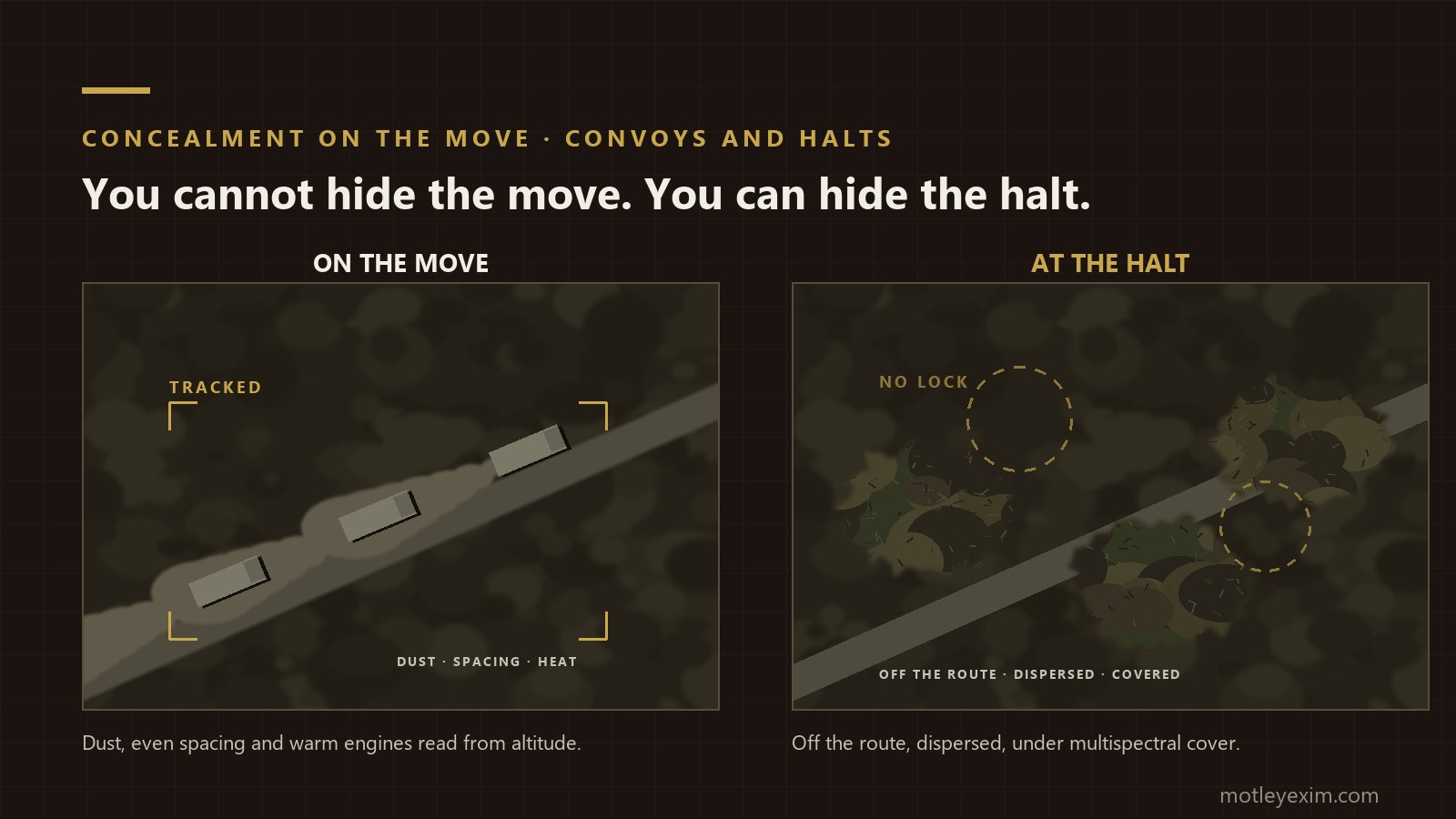
A static position can be made to disappear. A moving column cannot. Movement is the one thing every sensor and every observer is trained to notice, and a convoy adds dust, engine heat, fresh tracks and a predictable route on top of it. Concealment on the move is therefore about managing what shows and for how long, and about being ready for the moment that matters most: the halt. This guide follows on from camouflage and concealment doctrine and our guide to concealing fixed installations.
TL;DR
- You cannot hide the move; you can hide the halt. Concealment on the move is signature management, not invisibility.
- What gives a column away is usually around it: dust, tracks, even spacing, warm engines and a predictable route.
- At a halt: get off the route, disperse, use natural cover first, then get multispectral cover over the vehicles.
- Deployment and recovery time belong in the specification — cover that is slow to rig does not get used on a short halt.
- Radar-attenuating cover over equipment that should disappear; radar-transparent cover over vehicles that must keep transmitting.
Why movement is the hardest concealment problem
Every part of camouflage works better when nothing changes. Break up an outline, match a background, manage heat, and a position can sit unnoticed for as long as the discipline holds. A convoy has none of that. It changes the scene continuously, and change is exactly what both a human analyst and an automated detection model are looking for.
So concealment on the move sets a narrower goal: show less, for less time, and in fewer places. That means the signature of the column, the route it takes, the timing it keeps, and how quickly it can disappear when it stops.
What gives a convoy away
Most of the giveaways are around the vehicles rather than on them. A dust plume is visible far beyond the column itself and lingers after it has passed. Fresh tracks record where it came from, where it turned off and where it stopped. Evenly spaced shapes moving in line read as man-made at a glance from altitude. Warm engines, exhausts and wheel hubs stand out on a thermal image well after the vehicles stop — our explainer on thermal signature covers why heat lingers.
Repeated observation adds the last one. A route used at the same time each day becomes a pattern, and a pattern is what makes a column easy to find without searching for it. That is the same change-detection logic that threatens fixed sites, described in our guide to depots and fixed installations, and it applies just as much to a road move.
Route, spacing and timing
The cheapest concealment on the move costs nothing but planning. Terrain that masks a route from the likeliest direction of observation is worth more than any material. Varying spacing breaks the regularity that reads as a column. Varying routes and departure times breaks the pattern that repeated passes rely on. Dust can be reduced by speed and spacing choices on the worst surfaces, and by avoiding the driest tracks where an alternative exists.
Drone observation has made this discipline more demanding rather than less, because a small aircraft can watch a route for a long time from a modest height — the problem covered in our anti-drone camouflage guide.
The halt is where concealment is won
A halt is the moment the column becomes a static target, and also the moment concealment starts working again. The sequence matters: get off the route so the halt is not on the obvious line, use natural cover — treelines, folds in the ground, shadow — before any material is unrolled, disperse so one pass cannot cover everything, and only then rig cover over the vehicles.
Tracks deserve as much attention as the vehicles. A short spur leading off a route to a stand of trees is exactly the kind of detail an analyst looks for, so keeping entry and exit tracks few, and avoiding fresh clearings, protects the position more than an extra layer of net. Our note on support system setup covers rigging cover quickly and keeping it clear of hot surfaces.
Cover that travels
Camouflage that lives on a vehicle has to survive being rigged, recovered, packed wet and rigged again, often by a tired crew in the dark. That makes deployment speed, packed size and durability part of the concealment, not separate from it.
The material choice follows the threat. Three-dimensional multispectral nets break up the outline and manage the visible, near-infrared, short-wave infrared and thermal bands together. A radar-attenuating net suits vehicles and equipment that should disappear from radar, while a radar-transparent net is what goes over a vehicle that has to keep transmitting or receiving. Anti-thermal coatings and camouflage paints reduce the contrast of surfaces that stay exposed while moving.
What to specify
- Bands — visible, near-infrared, short-wave infrared, thermal and radar, stated separately.
- Deployment and recovery — how fast the crew that will actually use it can rig it and pack it away.
- Packed size and weight class — it has to travel on the vehicle it protects.
- Terrain and season — matched to the ground the route actually crosses.
- Durability — repeated rigging, travel, wet packing and rough handling.
- Fit — around antennas, hatches, weapon stations and hot surfaces.
- Fire behaviour — where fuel or ammunition is carried.
CAMPRO® multispectral camouflage nets are manufactured in India, with NABL-accredited lab test reports available on request; defence exports are subject to India's SCOMET export-control framework. For the wider requirement, see how to specify a multispectral camouflage net, our guide to decoys and the complete guide to camouflage nets.
Frequently Asked Questions
Can a moving convoy be hidden?
Not in the way a static position can. A column on the move throws dust, warms its engines, breaks the pattern of the ground around it and has to follow a route someone can predict. What concealment can do on the move is reduce how much of that shows and for how long: spacing that avoids an obvious column, routes that use terrain to mask the move, timing that avoids the clearest observation, and cover that is ready to go up the moment the column stops.
What gives a convoy away from the air?
Usually the things around the vehicles rather than the vehicles themselves. Dust plumes are visible far beyond the column, fresh tracks show where it came from and where it turned off, evenly spaced shapes read as man-made from altitude, and warm engines and exhausts stand out on a thermal image long after a halt. Repeated observation adds one more: a route used at the same time every day becomes a pattern.
What should happen at a halt?
Get off the route, use whatever natural cover exists first, disperse rather than cluster, and get cover over the vehicles before anything else. Keep tracks in and out to a minimum and avoid making fresh clearings. The halt is where a column is most vulnerable and also where concealment actually works, because the vehicles are still.
How fast does camouflage need to go up at a halt?
Fast enough that the vehicles are covered before an overhead pass is likely. That is why deployment and recovery time by a small crew belongs in the specification, alongside packed size and weight class. A net that protects perfectly but takes too long to rig will not be used on a short halt.
Do camouflage nets work over vehicles with antennas and radios?
Yes, if the right net is chosen. A radar-attenuating net reduces the radar return of the vehicle underneath, but cover over a vehicle that must keep transmitting or receiving should be radar-transparent, so it conceals in the visible, infrared and thermal bands without blocking the vehicle's own signals.
What should be specified for vehicle and convoy camouflage?
The bands it must cover (visible, near-infrared, short-wave infrared, thermal and radar), the deployment and recovery time by the crew that will use it, packed size and weight class for the vehicle carrying it, terrain and season match, durability against repeated rigging and travel, fit around antennas, hatches and hot surfaces, and fire retardancy where fuel and ammunition are carried.
Procurement or technical question?
CAMPRO® camouflage, CAM-IRR® paint, fire-suppression systems, and export-compliance support. Our team replies within one business day.
Contact Our Team →