
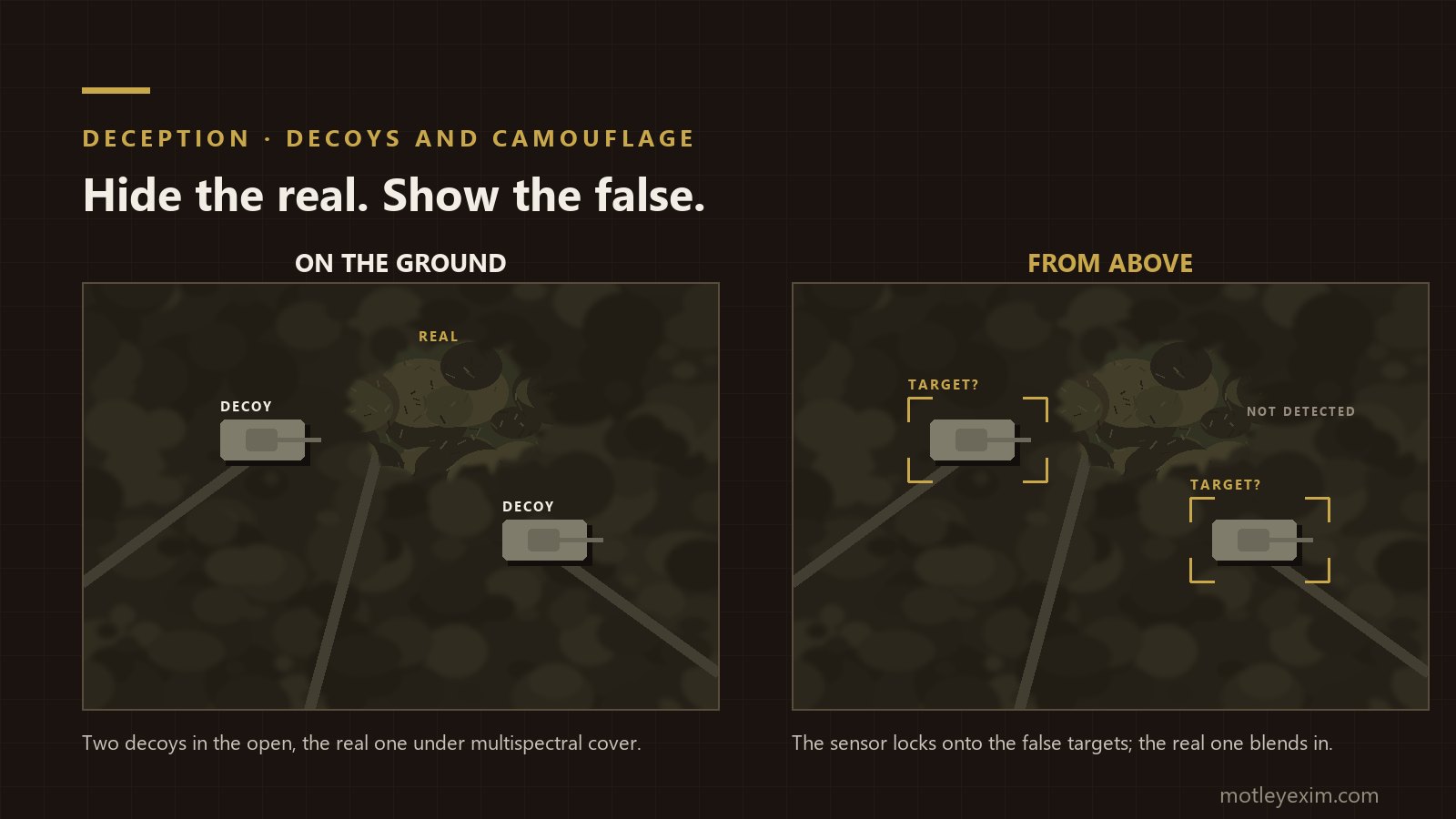
Camouflage tries to make the real thing disappear. A decoy does the opposite: it is built to be seen. Used together, they force an observer to guess, and every false target that gets investigated, tracked or struck is time and effort not spent on the real one. This guide looks at what makes a decoy believable to the sensors that watch a battlefield today, where decoys fail, and how they fit alongside the concealment of the real asset. It builds on our notes on camouflage and concealment doctrine and concealment from satellite and aerial ISR.
TL;DR
- Camouflage hides the real asset; a decoy gives the enemy something false to find.
- A decoy must match the real asset's signatures on camera, night vision, thermal and radar — failing one sensor exposes it.
- Placement, tracks and regular movement matter as much as the replica itself.
- Decoys only work if the real asset is harder to find than they are.
- Plan decoys and concealment together, not one after the other.
Why decoys belong alongside camouflage
Camouflage and decoys answer the same threat from opposite directions. Camouflage reduces what an observer can see; a decoy adds something false for the observer to find. Used together they turn detection into a guessing game: every target has to be confirmed before it is engaged, and every false target soaks up time, attention and sometimes munitions that would otherwise be spent on the real thing.
That is the idea behind the old rule of military deception — hide the real, show the false. Our note on camouflage and concealment doctrine covers deception as a principle; this guide is about the decoys themselves, and what it takes for them to hold up.
What makes a decoy believable
A decoy has to survive the same sensors as the asset it copies. To a daylight camera that means the right shape, size, colour and shadow. To a night-vision device it means sensible reflectance in the near-infrared. To a thermal camera it means heat in the right places at the right times — our explainer on thermal signature shows why that matters. To radar it means a return of roughly the right strength and shape; see radar cross-section.
A decoy that passes one sensor and fails another is often exposed by the comparison itself, especially where overhead observation combines several bands. The spectrum primer sets out what each band reveals, and a credible decoy has to be designed against all of the ones the adversary is likely to use.
Types of decoys
Decoys range from simple to sophisticated. Visual dummies — rigid frames, panels or inflatable shapes — copy outline and colour. Thermal decoys add heat sources so that a vehicle or generator shows up warm on a thermal image. Radar decoys use reflective surfaces or corner-reflector geometry to return a convincing radar signature.
The most credible designs combine all three, and a full decoy position goes further than the object: tracks leading in and out, disturbed ground, and the small signs of activity a real unit leaves behind. A lone replica on untouched ground can look more like a trap than a target.
Placement, activity and change detection
A perfect replica in the wrong place is still a giveaway. Decoys need plausible positions — where a real unit would actually deploy, at a realistic spacing, with the access routes a real position would need. They also need to change: overhead observation compares images over time, and a decoy that never moves while everything around it does becomes suspicious.
Our guide to concealing fixed installations and depots explains how change detection works, and the same logic applies in reverse to decoys: rotate them, refresh the tracks around them, and keep their pattern of activity consistent with the story they are meant to tell. Drone observation makes this more demanding, as covered in our anti-drone camouflage guide.
Protecting the real asset
Decoys only work if the real asset is harder to find than they are. That puts the stronger concealment on the real position: multispectral camouflage nets that reduce its visible, near-infrared, thermal and radar signature, a radar-attenuating net over equipment that should disappear from radar, a radar-transparent net over systems that must keep transmitting, and anti-thermal coatings on exposed surfaces.
The test is simple: if the real vehicle is the warmest, brightest or most reflective object in the area, the decoys have been wasted. Concealment and deception have to be planned as one scheme, so that the false targets are always the easier ones to find.
What to plan and specify
- Sensors — which of visible, near-infrared, thermal and radar the decoy must satisfy.
- Signature match — shape, colour, heat pattern and radar return consistent with the real asset.
- Deployment — how quickly a small crew can set it up, move it and pack it away.
- Durability — how it holds up to wind, sun, rain and repeated handling.
- Placement plan — plausible positions, tracks and a schedule for moving decoys.
- Concealment of the real asset — multispectral cover that keeps the real thing harder to find than the false one.
CAMPRO® multispectral camouflage nets are manufactured in India, with NABL-accredited lab test reports available on request; defence exports are subject to India's SCOMET export-control framework. For the concealment side of a deception plan, see how to specify a multispectral camouflage net, our anti-drone camouflage solutions and the complete guide to camouflage nets.
Frequently Asked Questions
What is a military decoy?
A military decoy is a replica of a real asset — a vehicle, a gun position, an aircraft or a radar — built to be found. Where camouflage tries to make the real thing disappear, a decoy gives an observer something false to detect, track and possibly strike. The two work together: hide the real, show the false.
Do decoys still work against drones and satellites?
They can, but only if they hold up to the sensors that are actually looking. Modern observation combines visible cameras, near-infrared, thermal imaging and radar, often over several passes. A decoy that looks right in a daylight photo but is cold on a thermal image, or gives no radar return, is quickly exposed. Decoys that match the real asset's signatures and change position over time stay credible much longer.
How does a decoy fool a thermal camera?
By producing heat where the real asset would. A thermal camera reads temperature contrast, so a decoy of a vehicle or generator needs warm areas in plausible places — engine deck, exhaust, crew positions — at plausible times of day. A decoy with no heat, or with heat in the wrong place, stands out as fake.
What is a radar decoy?
A radar decoy is built to return a radar signature similar to the real asset's. Metal surfaces, reflective materials and corner-reflector shapes can make a lightweight structure look like a vehicle or an installation to a radar or synthetic-aperture sensor, which sees reflection rather than appearance.
Should decoys be camouflaged too?
Usually, yes — lightly. A real unit is rarely left completely exposed, so a decoy standing fully in the open can look too easy. Partial concealment, tracks and the small signs of activity a real position would show make a decoy far more convincing. The real asset, meanwhile, needs the stronger concealment of the two.
How are decoys used with camouflage nets?
Camouflage nets do two jobs in a deception plan. Over the real asset, multispectral nets reduce its visible, near-infrared, thermal and radar signature so it blends into the background. Over a decoy, a net can create the look of a partly hidden position. What matters is that the real asset ends up harder to find than the decoys.
Procurement or technical question?
CAMPRO® camouflage, CAM-IRR® paint, fire-suppression systems, and export-compliance support. Our team replies within one business day.
Contact Our Team →