
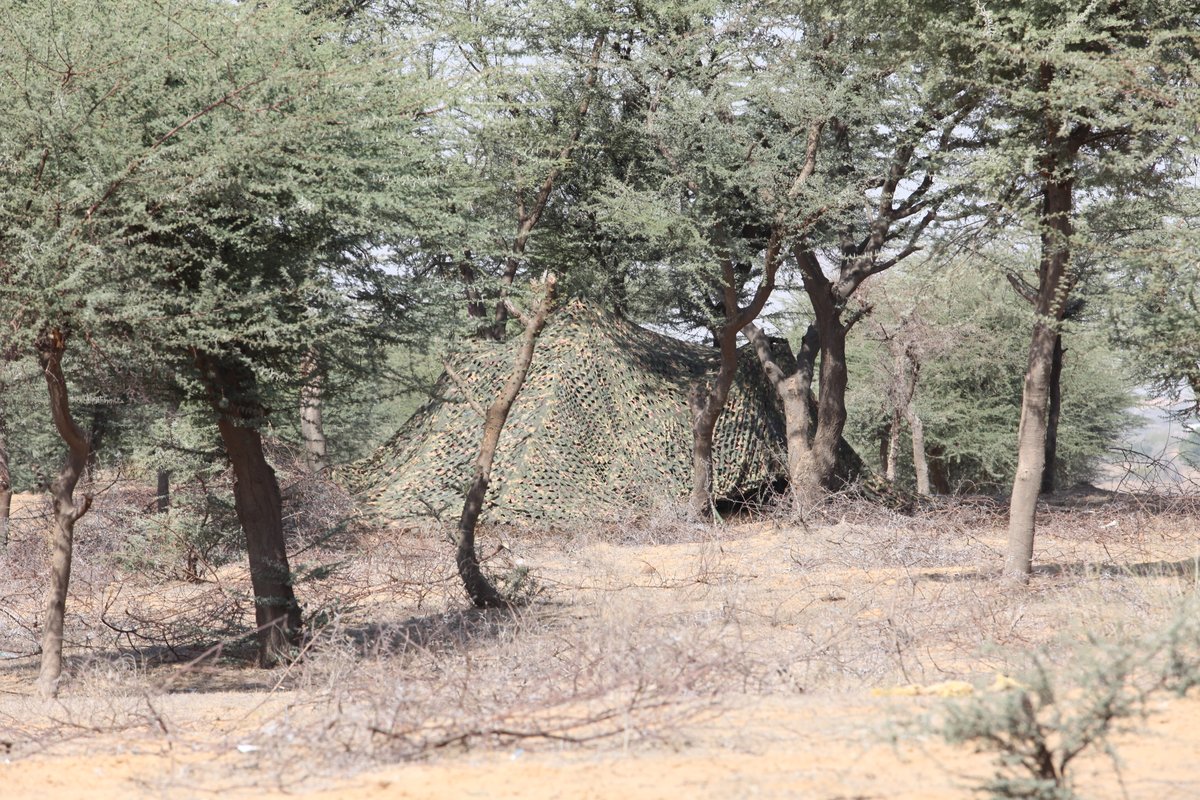
Search for a camouflage net online and two products sit side by side that could hardly be more different: a low-cost printed mesh sold for garden shade and hunting hides, and an engineered military system built to hide a vehicle from thermal imagers and radar. They share a name and almost nothing else. This guide explains the real difference — what each one actually does, where each belongs, and how to tell them apart before you buy.
TL;DR
- A commercial or shade net works in one band only — the visible. It changes how something looks to the eye, and nothing more.
- A military camouflage net manages an asset’s signature across several bands at once — visible, near-infrared, thermal, and, in some types, radar.
- Under night vision or a thermal sight, a printed commercial net offers little concealment; a multi-spectral net is engineered for exactly those sensors.
- Materials, durability, flame-retardancy, testing and price differ accordingly — the two are not substitutes.
- For garden shade or a hunting hide, a commercial net is fine. For defence use, only a military-grade net does the job.
‘Camouflage net’ can mean two very different things
The phrase covers everything from a lightweight printed mesh to a defence-grade signature-management system. The confusion matters because buyers sometimes assume a low-cost net will ‘hide’ equipment from modern surveillance — and it will not. The gap between the two is not about quality alone; the products are engineered against completely different problems. For a full technical breakdown of the military category, see our guide to the camouflage net.
Commercial, shade and agricultural netting
Commercial nets — sold for garden shade, sports grounds, hunting hides and general-purpose concealment — are designed for the human eye in daylight. A printed or woven pattern in green, tan or jungle colours breaks up an outline and provides shade. For those uses that is enough.
What they do not do: they are not engineered for near-infrared, they do not manage heat, and they are transparent to radar. Under a night-vision device or a thermal imager, the equipment underneath is usually as visible as if the net were not there. Materials are typically low-cost polyethylene or similar, chosen for price and shade factor rather than durability or signature control.
Military camouflage net: multi-spectral signature management
A military camouflage net is a different class of product. It is engineered to manage what an asset gives off across several sensor bands at once:
- Visible. Colour and disruptive pattern matched to the background, with three-dimensional garnish to break up shadow and shape.
- Near-infrared. Controlled reflectance so the net does not betray itself under night-vision devices.
- Thermal. Managed emissivity and physical decoupling to cut the heat signature the net presents to a thermal imager.
- Radar. In radar-managed or radar-transparent variants, a defined behaviour against battlefield radar.
This multi-band approach is what defines the category. Our complete guide to multi-spectral camouflage walks through each band in turn.
The key differences, side by side
- Bands defeated. Commercial: the visible band only. Military: visible, near-infrared and thermal, plus radar in some types.
- Against night vision and thermal. Commercial: little to none. Military: engineered for exactly these sensors.
- Materials and durability. Commercial: low-cost mesh for shade. Military: engineered textiles built to hold their signature and strength after ultraviolet, abrasion and weather.
- Flame-retardancy and safety. Commercial: usually unspecified. Military: flame-retardant and other safety properties specified.
- Testing and evidence. Commercial: none. Military: measured at accredited laboratories — see our note on NABL certification — against stated methods.
- Price and lifecycle. Commercial: cheap up front. Military: higher unit cost, justified by the sensors it defeats and its service life.
When each is the right choice
Be honest about the requirement. If you need shade over a yard, a screen for a hunting hide, or a decorative jungle-print backdrop, a commercial net is the correct and economical choice — a military net would be overkill. But if the goal is to conceal a vehicle, gun position, shelter or installation from an adversary using night vision, thermal imaging or radar, only a military multi-spectral net will actually work. Choosing a commercial net for a defence task is not a saving; it is an expensive way to stay visible.
How to tell them apart when buying
A few questions separate the two immediately:
- Does the seller state which sensor bands the net addresses — near-infrared, thermal, radar — or only a colour and a shade factor?
- Is there independent test evidence (accredited laboratory, stated method) for signature performance, or only a product photo and a price?
- Are durability and flame-retardancy specified, or unmentioned?
- Is it described as ‘multi-spectral’, ‘radar-transparent’ or ‘NIR-matched’, or simply as a ‘camo net’ for shade and hunting?
If the answers are colour-and-price only, it is a commercial net. If they name bands, standards and test evidence, it is a military-grade system. For the full specification checklist, see how to specify a multispectral camouflage net. Both products are useful — but only for the job each was built to do.
Frequently Asked Questions
Can I use a garden or shade net for military concealment?
No. A garden or shade net works only in the visible band; it does not manage near-infrared, thermal or radar, so under night vision or a thermal imager the equipment underneath stays visible. Military tasks need a multi-spectral net engineered for those sensors.
Does a commercial camouflage net block thermal imaging?
No. Commercial netting is not engineered for the thermal band, so a thermal imager reads the heat of the equipment straight through it. Defeating thermal requires emissivity management and physical decoupling, which are features of military multi-spectral nets.
Why does a military camouflage net cost more?
Because it solves a much harder problem: managing a signature across several sensor bands using engineered materials that hold their performance after ageing, backed by accredited testing. The price reflects the sensors it defeats and its service life, not just the fabric.
Is jungle-print netting the same as a multi-spectral net?
No. A jungle print addresses only how something looks to the eye. A multi-spectral net matches the visible, near-infrared and thermal bands, and radar in some types, which a printed commercial net does not.
What standards should a military camouflage net meet?
Look for signature performance measured at an accredited laboratory such as NABL against stated methods, references to standards like MIL-PRF-53134 and NATO STANAG test methods, and specified durability and flame-retardancy — not just a colour and a price.
Where can I buy a genuine military camouflage net?
From a defence-grade manufacturer that can state the bands its nets address and provide test evidence. Motley Exim Co. (CAMPRO®) manufactures multi-spectral, radar-transparent and high-attenuation camouflage nets in India; you can request specifications through the site.
Procurement or technical question?
CAMPRO® camouflage, CAM-IRR® paint, fire-suppression systems, and export-compliance support. Our team replies within one business day.
Contact Our Team →