
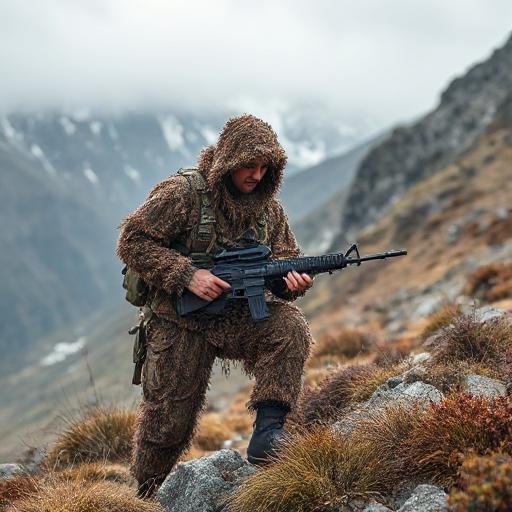
Does a ghillie suit hide you from a thermal camera? Not on its own. A standard ghillie suit breaks up your outline and colour for the human eye, but your body keeps producing heat, and a thermal camera reads that heat straight through garnish and fabric. A thermal ghillie suit adds materials that control how body heat reaches the outer surface, so the wearer stops showing as a sharp, warm human shape. It reduces the signature rather than erasing it, and how well it works depends on time, weather, background and discipline.
TL;DR
- A standard ghillie suit does not block thermal imaging — it hides shape and colour, not body heat.
- A thermal ghillie suit manages how heat reaches the outer surface and breaks the warm human outline into irregular patches.
- It lowers the thermal signature; it does not make the wearer invisible.
- Heat builds up the longer the wearer stays still, and sun, weather, background and movement all change how well it works.
- Look for coverage across visible, near-infrared, short-wave infrared and thermal bands, not a thermal-only claim.
How a thermal camera sees a person
A thermal camera does not need light. It builds its picture from the heat that every surface gives off, and a living person is usually warmer than the ground, vegetation and air around them, especially at night. The head, face and hands show up brightest, and the overall outline — head, shoulders and limbs — is what an observer or an automated detection model recognises first. Our explainer on what a thermal signature is covers how that contrast works, and the spectrum primer shows where thermal imaging sits alongside the other bands.
Why a standard ghillie suit is not enough
A traditional ghillie suit was designed for the human eye. Its garnish breaks up the wearer's outline and matches the colour and texture of the surroundings, which is still valuable against someone with binoculars. It does very little against a thermal camera: the fabric warms up from the body underneath, heat escapes around the head, hands and openings, and the warm shape shows through the garnish.
There is a second gap that is easy to miss. Night-vision devices amplify faint light, much of it in the near-infrared, and many fabrics and dyes that look right in daylight reflect very differently there. A suit can match the background to the eye and still stand out through night vision.
What a thermal ghillie suit changes
A thermal ghillie suit treats heat as part of the camouflage problem rather than an afterthought. Layered materials slow the rate at which body heat reaches the outer surface, and the outer layers are chosen so that what they give off sits closer to the background. Three-dimensional garnish then breaks whatever warmth does reach the surface into irregular patches instead of a clean human silhouette.
The better designs manage several bands at once. The CAMPRO® multispectral camouflage ghillie suit is built for the visible, near-infrared, short-wave infrared and thermal bands together, and the reversible sniper suit covers the same bands with two patterns for switching terrain. The 3D shape-adaptive sniper suit works on the outline itself, moulding to mimic the surrounding terrain. For the wider family of garments built around infrared signature, see anti-thermal ghillie suits explained.
Where it stops working
No suit removes the heat a person produces; it manages it, and that management has limits. The longer the wearer stays still, the more heat builds up in the layers and the warmer the outer surface becomes. Direct sun heats the suit from outside during the day. Around dawn and dusk the background itself warms and cools, so the contrast between wearer and surroundings keeps shifting. Movement, an exposed face or hands, warm equipment beside the wearer, and a background the suit was not chosen for — sun-heated rock instead of cool grass, for example — can all give a position away.
That is why field discipline matters as much as the suit: choosing positions with cover and shade, limiting movement, and managing everything else the wearer carries. The same principles apply to vehicles and positions, covered in our guide to camouflage and concealment doctrine.
What to check before buying
- Bands covered — visible, near-infrared, short-wave infrared and thermal, stated band by band rather than a single "anti-thermal" label.
- Coverage — head, face, hands and weapon, not just the torso and legs.
- Heat build-up — how the suit behaves over a long static period, and how breathable it is.
- Terrain and season — colour, garnish and materials matched to where it will actually be used.
- Durability — garnish retention, and how colour and coatings hold up to sun, rain and repeated use.
- Test evidence — independent laboratory reports you can see, not a figure on a datasheet.
CAMPRO® products are manufactured in India, and defence exports are subject to India's SCOMET export-control framework. For the full range, see our anti-thermal and IR camouflage guide.
Frequently Asked Questions
Do ghillie suits block thermal imaging?
A standard ghillie suit does not. It breaks up your outline and colour for the human eye, but your body heat still reaches the surface and a thermal camera reads it through the garnish. A thermal ghillie suit adds materials that control how that heat reaches the outer surface and breaks the warm outline into patches, which lowers the thermal signature without making the wearer invisible.
What is an IR suit?
"IR suit" usually means a garment designed to reduce the wearer's infrared signature. That can mean the near-infrared light that night-vision devices amplify, the thermal band that thermal cameras see, or both, and they are different problems. When comparing products, check which bands a suit is actually designed for rather than relying on the label.
Does a thermal ghillie suit make you invisible?
No. It reduces the contrast between the wearer and the background, so the person stops reading as a clear, warm human shape, but the heat is managed rather than removed. Time, sun, weather, background and movement all affect how well it works, which is why field discipline matters as much as the suit.
Can a thermal ghillie suit hide you from night-vision devices?
Only if it is designed for the near-infrared as well. Night-vision devices amplify faint light, much of it in the near-infrared, where many fabrics and dyes that look right in daylight reflect very differently. A multispectral suit addresses the visible, near-infrared, short-wave infrared and thermal bands together; a thermal-only suit may still stand out through night vision.
How long does a thermal ghillie suit last?
It depends on how it is used and stored. Garnish loosens with repeated deployment, and sun, rain and abrasion wear colours and coatings over time, which can change how the suit behaves in the infrared bands even while it still looks fine. Regular inspection and replacing worn sections keep it matched to the terrain.
What should you check before buying a thermal ghillie suit?
Check which bands it covers (visible, near-infrared, short-wave infrared and thermal), whether it covers the head, hands and weapon, how it handles heat build-up over a long static period, whether it suits your terrain and season, how durable the garnish and coatings are, and whether independent laboratory test reports are available.
Procurement or technical question?
CAMPRO® camouflage, CAM-IRR® paint, fire-suppression systems, and export-compliance support. Our team replies within one business day.
Contact Our Team →Thermal threat — sensors countered
Thermal-band sensors this addresses
Thermal detection comes from infrared search-and-track sets such as OLS-35 and PIRATE, imaging-infrared seekers such as AIM-9X and IRIS-T and the long-wave seeker of the FGM-148 Javelin, uncooled thermal weapon sights such as the AN/PAS-13, and aircraft suites such as the F-35’s EOTS and DAS. CAMPRO anti-thermal materials are engineered to flatten the thermal signature this class of sensor hunts. This guide is educational and states no product performance figures.