
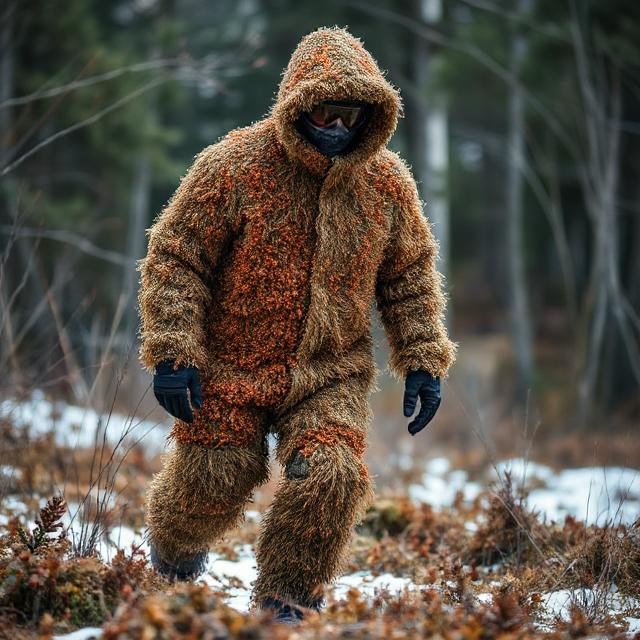
Anti-thermal suit materials are the layers that decide how a soldier appears to a thermal imager and to night vision: an insulating layer that slows body heat on its way out, an outer fabric whose infrared behaviour is matched to the ground, and garnish that breaks the outline, all on a flame-retardant base. No single fabric does the whole job; the layers are balanced against weight and breathability.
TL;DR
- A system, not a fabric: insulation, an infrared-managed outer layer and garnish work together; take one away and the suit stops working in that band.
- Insulation slows heat: it keeps the outer surface closer to the temperature of the ground, at the cost of heat building up inside the suit.
- The outer fabric is matched band by band: colour for the eye, near-infrared reflectance for night vision, emissivity for thermal imagers.
- Flame retardancy belongs in the fibre: an inherent flame-retardant fabric keeps the property through washing and wear; a surface finish can fade.
- Test the finished suit: ask for accredited laboratory reports on the suit as supplied, band by band, not only on the raw fabric.
What anti-thermal suit materials are
An anti-thermal suit works because of what it is made of. A standard uniform is one layer of printed fabric, chosen for colour, comfort and wear. An anti-thermal suit is a stack of layers, each with a job in a different part of the spectrum. The eye sees colour and pattern; a night-vision device sees how strongly the surface reflects near-infrared light; a thermal imager sees the heat the surface gives off. One fabric cannot answer all three, so the materials are chosen and combined as a system.
This page looks at the suit from the inside out: what each layer does, what it has to answer, the trade-offs between the layers, and how to check that the finished suit does what the materials promise.
The layers, from the skin outwards
- Inner layer. Next to the skin, the inner fabric moves sweat away and keeps the wearer working. It does little for concealment directly, but a suit that soaks through or overheats cannot be worn for long, and a suit that is not worn conceals nothing.
- Insulating layer. Between the body and the outer fabric, an insulating or spacer layer slows the rate at which heat travels outward. The outer surface then stays closer to the temperature of the ground around it, which is what a thermal imager compares.
- Infrared-managed outer fabric. The outer layer carries the terrain pattern for the eye, and its fibres, dyes and finishes are chosen for two further properties: how it reflects near-infrared light, and how strongly it radiates heat. These decide how the suit looks through night vision and through a thermal imager.
- Garnish and texture. Three-dimensional garnish, leaf cut-outs or loose strips sit on top. They break the clean human outline that the eye and the thermal image both look for, and they spread whatever warmth reaches the surface into irregular patches.
- Coverage items. Hood, face mask, gloves, rifle wrap and a cover for the pack. Face, hands and the weapon are small and warm and are what an observer searches for first, so they need the same materials as the jacket and trousers.
What each material has to answer, band by band
Each band asks a different question of the materials, which is why a suit should be specified band by band. Our explainer on the UV, near-infrared and thermal spectrum sets out the bands in more detail.
- Visual. Colour, pattern and texture matched to the terrain and season: jungle, plains, desert, mountain, snow or urban ground.
- Ultraviolet. Matters mostly on snow. Snow reflects ultraviolet strongly and many white fabrics do not, so a suit that looks right to the eye can stand out through ultraviolet-sensitive optics.
- Near-infrared. Night-vision devices amplify reflected near-infrared light. Vegetation reflects a lot of it, so a fabric dyed only for colour can show as a dark shape against bright foliage. Dyes and finishes are chosen so that the reflectance follows the background.
- Short-wave infrared. Some sensors look further into the infrared, where fabrics, moisture and vegetation separate in different ways again. A suit matched in the near-infrared is not automatically matched here.
- Thermal. Thermal imagers read emitted heat. Here the insulation and the outer surface work together; our explainer on emissivity in thermal camouflage explains why two surfaces at the same temperature can look different on a thermal image.
The trade-offs: heat, weight and breathability
Every material choice in an anti-thermal suit costs something. More insulation keeps the surface cooler on a thermal image but holds more heat inside, and over a long static period that heat builds up until the surface warms anyway. A heavier, denser outer fabric can carry more pattern and finish but tires the wearer. Garnish breaks the outline but snags, catches and adds weight.
The balance depends on the climate and the task. A suit for a long static position on hot plains is built differently from one for a short move across snow. Weight is a fair guide to how far the balance has been pushed: a complete CAMPRO® MSCGS weighs under 2.9 kg, so the suit does not become the burden in a long stay in position.
Flame retardancy and durability
A suit worn in the field has to live with fire risk, sun, rain, mud, abrasion and repair. Two questions matter most.
- Inherent or finished? Flame retardancy can be built into the fibre or added as a surface finish. An inherent flame-retardant fabric keeps the property through washing and wear; a finish can wear away. Ask which it is.
- Does the infrared behaviour last? Colour fading is easy to see; a loss of near-infrared or thermal performance is not. Ask how the outer fabric and its finishes hold up to sunlight, washing and abrasion, and whether a damaged section can be patched in the field with the same materials.
Anti-thermal materials vs. conventional uniform fabric
A conventional uniform fabric is printed for the eye and finished for comfort and durability. Body heat passes straight through it, and its near-infrared reflectance is whatever its dyes happen to give. An anti-thermal suit keeps the idea of a terrain pattern but adds an insulating layer, an outer fabric chosen for its infrared behaviour, garnish to break the outline, and coverage for the face, hands and weapon. The result is a garment built for night vision and thermal imagers as well as the eye, at the cost of more weight and more heat inside the suit. Our guide to how anti-thermal and IR camouflage works covers the same principles for nets and paints.
How the materials are tested
Fabric data alone does not show how a suit performs, because layering, stitching, garnish and fit all change the result. Ask for tests on the finished suit, as supplied, from an accredited laboratory, with the method stated:
- visual colour and near-infrared reflectance against the terrain reference the suit is meant to match;
- short-wave infrared and ultraviolet behaviour where those bands are in the requirement;
- thermal behaviour of the outer surface compared with the background;
- flame retardancy of the fabric.
For the CAMPRO® MSCGS a test report from NABL laboratories is available on request; detailed figures are released under NDA after export-control screening.
CAMPRO® suits made in India
Motley Exim Co. makes CAMPRO® sniper and ghillie suits in New Delhi. The CAMPRO® MSCGS multispectral camouflage ghillie suit manages the wearer’s signature in five bands — ultraviolet, visual, near-infrared, short-wave infrared and thermal — on an inherent fire-retardant fabric, and is supplied as a complete kit: jacket, trouser, face mask, gloves, rifle wrap, bag cover, repair kit and an all-weather carry bag. The reversible sniper suit carries two patterns in one garment for two kinds of ground, and the 3D shape-adaptive sniper suit works on the outline itself. Suits are supplied for military use; defence exports need Indian export-control approval and a valid End-User Certificate.
To match a suit to the task, see our ghillie suit selection guide. If the question is whether an ordinary ghillie suit works against thermal imaging, our guide to the thermal ghillie suit answers it.
Frequently Asked Questions
What are anti-thermal suits made of?
Several layers working together: an inner layer for comfort and moisture, an insulating layer that slows body heat on its way out, an outer fabric chosen for colour, near-infrared reflectance and heat emission, and garnish that breaks the outline. The hood, face mask, gloves and rifle wrap carry the same materials to the parts of the body an observer finds first.
Can a single fabric hide a soldier from thermal imaging?
No. Thermal concealment comes from insulation, the infrared behaviour of the outer surface and a broken outline working together, and even then a suit lowers the contrast with the background rather than removing it. Exertion, exposed skin, sun on the suit and time all work against it.
Why does near-infrared reflectance matter for a suit?
Night-vision devices amplify reflected near-infrared light, and vegetation reflects a lot of it. A fabric dyed only for colour can appear as a dark, person-shaped patch against bright foliage. Dyes and finishes chosen for near-infrared reflectance keep the suit closer to the background through night vision.
Should flame retardancy be inherent or a finish?
Inherent, where possible. Flame retardancy built into the fibre stays through washing, sun and abrasion; a surface finish can wear away over the life of the suit. The CAMPRO® MSCGS is made of an inherent fire-retardant fabric.
How are anti-thermal suit materials tested?
On the finished suit rather than the raw fabric, in an accredited laboratory: visual and near-infrared reflectance against the terrain reference, the other bands where they are specified, thermal behaviour against the background, and flame retardancy. For the CAMPRO® MSCGS a test report from NABL laboratories is available on request.
Who can buy CAMPRO® anti-thermal suits?
CAMPRO® suits are supplied for military use. Defence exports need Indian export-control approval and a valid End-User Certificate, and supply is not available to sanctioned or embargoed destinations.
Procurement or technical question?
CAMPRO® camouflage, CAM-IRR® paint, fire-suppression systems, and export-compliance support. Our team replies within 48 hours.
Contact Our Team →Sensor threat — what the suit defeats
The sensors a sniper suit must defeat
A sniper or ghillie suit must answer the trained eye and electro-optical optics in the visible band, image-intensified night vision such as the AN/PVS-14 in the near-infrared, and uncooled thermal weapon sights such as the AN/PAS-13 and imaging-IR seekers in the thermal bands. CAMPRO multi-spectral sniper systems are engineered to break the signature this class of sensor reads. This guide is educational and states no product performance figures.